Showing posts with label Cam Best. Show all posts
For Father's Day, I wanted to interview my dad to hear how he experiences reading and writing in his everyday life. He was pivotal to middle school Cam's development as a writer, so I figured it would be appropriate to ask him about this experience, as well as his own writing style and literary interests.

I'll let the interview take it from here:


Second to the professor who taught his work, John Updike is our #1 on the list of Men We Hate. This was the first English class Alyssa and I had together, so, naturally, we sat together so we could chatter like little school girls over the 1960s Contemporary Literature we read.

Sure, shit-talking a dead (thank Jesus) writer isn't the classiest thing to do. Especially in front of a professor who --and I will frame this as delicately as possible -- definitely masturbates to The Maple Family series. It's petty, it doesn't accomplish anything, I'm disrespectful, I need stronger grounds for an argument against Updike beyond the notion that the man who taught Rabbit, Run failed to anticipate our objection of a text that so vulgarly painted women in the oil paint sludge of their sexual employment for men.


As the upcoming series director, Andrew Davies, notes: "Some of the things have been a bit difficult for young intelligent females to cope with... but I think [Updike's] insight into both men and women is just so extraordinary"


In contrast, I think that Updike had insight equal to putting your penis in a toaster.


I did not finish reading Rabbit, Run.
It is one of few books I've abandoned, period, and perhaps one of two that I did not finish reading in college. Apparently, the baby drowns.

So let's address what information I barely remember from that penny dreadful: the novel was a thinly veiled recount of Updike's own extramarital affairs with seemingly no plot or continued conflict beyond what Rabbit created for himself. Oh no, making love to two women is hard, which one do I dispose? Why do I still feel like an empty, wrinkled scrotum? Things were so much easier when all that was expect of me was to literally run away from my problems.

I could go fish through my college notebooks for the page-by-page summary I created for it, or the contextual notes I jotted down, or how redemption and Kierkegaard's philosophy shape Updike's writing. Except, if I did all of that, I'd probably induce a brain aneurism.

So instead, let's come up with the two most ridiculous notions of Updike's writing that I've failed to appreciate:

1. Rabbit's existentialism as an excuse for his reckless actions and vulgar thoughts
2. Rabbit's disrespect for, manipulation of, and disposal of women [this might lack parallelism, so ad hominem me and sue me]

Kierkegaard, known as "The Father of Existentialism" in philosophy, is the thundering bass guitar of this self-indulgent cacophony. Who knows, maybe there is some redemption to his beliefs, but certainly not as they serve Rabbit, Run. Rabbit's existentialism is the average mid-life crisis: I'm old (he's 26) , life is ephemeral, my wife doesn't look hot anymore. The "spiritual enlightenment" path that Rabbit takes to redeem his soul from God's alienation is to ditch his pregnant wife, have a months long extramarital affair, and move in with that younger woman.

From my recollection, our class stopped at analyzing Kierkegaard after assigning passages of the text with different stages of existential crisis, thereby downplaying the fact that Rabbit alienated himself by zigzagging back & forth between his wife, Janice, and his side-chick, Ruth. "Zigzagging", specifically, because that is what a rabbit does when distressed to escape death, as my classmates and professor noted. As though between each zig and zag, a rabbit has sex with the zig, gets tired, goes for the zag, who rejects him, then back again to the zig.

Alienation through self-destructive behavior is not uncommon - ask my depression. It happens - but it is not excusable. If you drink to forget that you're upset, and you... I don't know, accidentally drown your baby...whether or not you blackout, it's socially expected to show remorse for "what you could not control" Because it starts with that first choice: that reaction to despair. "My ennui made me cheat on you" or "It's not my fault that you felt morose and drank to forget that I cheated on you and then accidentally drowned our baby" is the equivalent of Albert Camus' "The sun made me do it" No, bird brains: your narcissism, impulsivity, and -10 Ability Score in Kohlberg's Morality made you do it.

Updike said that this novel was an exploration of "the everyman" in middle class 1950s and his conflicting feelings about sex, religion,, death, sex, identity...sex.

It's difficult for me to identify Updike's tone - it's certainly not condemnation... maybe complacency, this exploration of this changing era that somehow tolerates marital and extramarital sexual assault. My regrettable experiences on Tinder & other "dating apps" take me back to Rabbit, Run, to this man who is the protagonist of everyone's world, who launch into phrases like "please tell me you're here for the ass-eats (heart eyes emoji) " or "well f--k you, b---h" when faced with rejection, or abandons you before you can abandon them (ghosting)

It makes me wonder if Updike, had he his own moral compass, could have written Rabbit, Run with more than ennui. Imagine if his tale of the everyman was a story of The Everyman, a character traveling through sins and refining his soul before physical or spiritual death... but maybe I've spent too much time with my tarot deck.

What does this text say of men of the past and of men of the present? What does this say about their viewpoints of women, or how women really react to these cave man brains and primal dicks? What discussions could our primarily female class have had about this text if our voices weren't reactionary to our male professor's, but instead interpersonal, as though he weren't in the room? What viewpoints could we have exchanged, or what realization could I have come to about this text? What could I have felt beyond disrespect, beyond objectification... what was my existentialism?


I don't know. I cannot speak. I'm simply a walking vagina.


Playing The Sims has always been a fast-burning flame.
Exhibit A: thirteen-year-old Cam binge-downloading hundreds of wallpapers, floor tiles, and eye colors.
Exhibit B: thirteen-year-old Cam, two weeks later, uninstalling the game and all the recently acquired add-ons.

It comes with a guilty solace: controlling an animated version of yourself and your friends instead of interacting with one another in real-life, spending hours completing mundane tasks to get that +1 Cleaning skills when your real mother has to remind you seventeen times to empty the real dishwasher.
A once-in-a-lifetime moment of Sims me doing the dishes

But there is always one aspect of which I never seem to tire: World Building. Break open that Build Mode. Sink that entire lot into a pond. Throw in a dozen more windmills. Name that Downtown "Telenovela".

The demands of World Building are seemingly endless: what does the terrain look like? what natural disasters are common? how do people dress? what's the architectural style? what jobs do everyday people have? is there magic?

As both a visual and linguistic artist, trying to keep straight all those images in my head get confusing. I just spent five minutes yesterday trying to remember a character's mom's name because I never got around to making a family tree. But having the opportunity to construct houses for the characters in my story is hands-down one of the best things my tweenage self ever discovered.

One of many houses, exterior. Interiors are (c)

First off, designing a house for your characters gives you a realistic view of space, style, and dimensions. Using The Sims to render a 3D model is vastly more impressive than a simple paper and pencil drawing. I will forever know that my girl Samantha climbs up the stairs and takes a right to walk down a long hallway to get to her bedroom. I'll know the north and east windows let in way too much sunlight every morning, and not even the massive maple tree on the east side can block out that ball of fire.

I'm forced to consider aspects I might have otherwise overlooked, like if characters would keep their bedrooms messy or neat, what colors they like, what clothes they'd own. It becomes obvious that I'm not just building a house, but I'm crafting a home, and I'm exploring the character through the space they live in.

I will spend hours on hours constructing a home before I start designing a Sims family to live there, if ever. You cannot honestly tell me you've considered how many baths & half-baths your protagonist's home has, or what kind of light fixtures there are, or how much counter space is in the kitchen. We just think that stuff is just "there" and worry about our character's love-square about to fly off the tracks. BUT SOMETHING MUST BE SAID FOR DESIGNING EVERY TILE PATTERN, WINDOW CURTAIN, OR WALLPAPER SWATCH.

A diagram showing how you can customize furniture by texture / pattern, layers, and 256 coloring (by Norma Blackburn of Carl's Sims 3 Guide)

One aspect about The Sims 3 that I'm working to death is the ability to customize the color of anything: ever 256 shade/hue/tint is available to you, dozens of patterns/textures/woodgrains. You can get so specific. You can really see if a mahogany wood looks alright with cerulean-painted walls, or if that white leather sofa will look nicer next to that black bookcase or maple-wood door.

You can view the house from 360 degrees, from a bird's eye, a worm's eye. You think about the landscaping, or if there's a 1 or 2-car garage, or what kind of fencing you should have for your fenced-in yard.

Let's end with this so I don't go on for an eternity about The Sims: when the author knows what the environment / building / home looks like for their characters, they are less likely to make simple mistakes describing the layout. In fact, they are more likely to actually describe the layout, which will help your readers better imagine what the world looks like, which means your characters won't just be walking around in a box.

I spent fifteen minutes of a twenty minute grocery trip in the liquor aisles tonight. I seldom drank in college, but the four months I've spent at my first job are tombstone-marked by empty bottles beside the end table in my bedroom. These aren't the only bottles keeping track of me.
I've been taking anti-depressants for almost seven months, and let's be clear that mixing SSRIs with alcohol once a week, or three days in a row, or any increment of time other than "intermittently" packs a suckerpunch of health risks. There's something very Beatnik about mixing prescription drugs with alcohol.
Clockwise from top left, skeletal diagrams of the neurotransmitters serotonin, dopamine, norepinephrine, and epinephrine. Diagrams from Wikimedia Commons.

I hate the Beatniks.

There's always been a bad taste in my mouth when I read writing inspired by someone's drug use. I don't regard my art as my own if taking a substance that modifies me is to take credit for my creativity. There's a lot to do with intent behind it: I don't agree with choosing to take some mind-altering substance in order to create art. It feels cheap to me -- like, what, you weren't creative enough on your own? Steroids build muscle and water is wet -- you just don't have enough of a drive or the skills or the talent to succeed the God blessed American way through hard work and tenacity.

To me, artwork inspired by and promoting drug use isn't something with which I connect. I guess Bush's War on Drugs really did succeed - thanks, D.A.R.E.

During my teen years, I mentally cautioned myself against getting mixed up in drugs --whether they were hard, soft, smoked, injected, cheap, expensive. I knew that, as an artist, I had an addictive personality, and substances are typically, you know, addictive.
Now, I've found myself using alcohol to fall asleep, or to feel happy and carefree for once. It's even inspired a poem for me.

Because I've been using SSRIs and alcohol to cope through this depressive period, I decided to try a style of poetry I was first introduced to by our loving and lovely leader, Alli. The form is a palindrome: a poem that can be read forwards and backwards, producing two meanings or stories from one form. It's a BOGO deal! Some common palindrome words or phrases are racecar, borrow or rob? , or red rum, sir, is murder.
I regret to inform you that "palindrome" is not a palindrome.

Damn Beatniks. Photo courtesy of The Onion

Though the poem itself was about alcohol, the difficulty of crafting a palindrome required sobriety. This kind of inspiration from alcohol seems a bit ass-backwards and atypical, though, and a choice of which I think the Beatniks wouldn't be too fond. I don't know if I'd be open to appreciating artwork inspired by someone's drug use, though the concept has crept into my own life in an unexpected way. It's definitely something I need more exposure to and consideration of.

--Cam


I used to play in a band with a friend who referred to cannabis as "green inspiration", the implication not only being that was inspiration something that he could turn on and off through his consumption of marijuana, but that inspiration would not come unless he smoked. In this way, he used art-making as a way to excuse a frankly disgusting habit.

On one hand, I resent artists who lean on mood-altering substances of any type for inspiration, if only because it impedes collaboration. As a songwriter and a former bandleader, I have had to wrangle musicians who have shown up to performances or recording sessions lit up like a pinball machine, stoned out of their gourds, rolling down paradise parkway, monkey tripping, candy flipping, or good old-fashioned drunk. These incidents almost always resulted in my best impression of J.K. Simmons' Dr Fletcher from Whiplash.

On he other hand, while keeping in mind that mood-altering substances should never be a crutch, I nevertheless support the idea that they provide crucial supports in the creative process and in living. We all do drugs, in one way or another. But please do not misunderstand me - by "drugs" I do not strictly mean "controlled substances" or "psychedelics" or "uppers and downers". We all have some sort of habit, either regular or irregular, that we use to regulate our moods and support ourselves in our creative lives. Philosopher Alain de Botton has cited, in his School of Life videos, that his drug of choice is, based on this definition, emmental cheese.

Increasingly, I have become interested in what drug use means as a wider social phenomenon. My generation is one that came of age between years of peak methamphetamine and cocaine overdose deaths (2007) and peak opioid overdose (2016, but perhaps 2017 or 2018). What are we to make of that? My generation has embraced the use of adderall and microdose LSD in order to maximize productivity. What are we to make of that? My generation holds a generally positive opinion regarding the use of magic mushrooms, ecstasy, and ayahuasca in mental health treatments, or even for "spiritual healing". What are we to make of that?

From the National Institute on Drug Abuse

Making sense of large-scale drug use trends usually means talking to drug enthusiasts, which has invariably led to some of the most frustratingly circuitous conversations of my life. Broadly speaking, drug users I have spoken to fall into one of three camps: supplementers, brain hackers, and oblivion seekers. Supplementers see drugs like cannabis, adderall, or microdose LSD as harmless supplements they can take to improve their day-to-day lives. These drug users see drugs as room for personal improvement, making them less anxious, more productive, more perceptive, or more outgoing. Brain hackers see the human mind as something than can be radically altered for the better by entheogens or psychedelics. They might be simply more intense supplementers, but more frequently they carry utopian visions - think Timothy Leary, Huxley's Doors of Perception, or Tao Lin's upcoming Trip - that radically from simpler self-improvement goals.

The benefits of brain hacking, from Tao Lin

The oblivion seeking mode of drug use, in my mind, represents the Thanatos to the other modes' Eros. A drinker looking to black out is an oblivion seeker, as is an individual who seeks out opioids, benzodiazepines, or other drugs that slow and mind and numb sensation. True, the current opioid crisis is due in large part to the greed of the Sackler pharmaceutical family and the flaws of the American healthcare system, but do what degree did these drugs satisfy a preexisting, Freudian death-drive? I don't have an answer to that. Not yet, at least.

--Vernon


It is a founding principle for old and new teachers alike: do not care whether your students like you or not. Easier said than done when you’re just a sucker with no self-esteem.

But teachers have bigger problems to worry about: if you’re going to be fired because your test scores weren’t high enough, differentiating instruction, student attendance, cantankerous parents, Betsy “Satan’s left testicle” DeVos. You’re not in middle school anymore – you’re teaching middle school. You don’t need a good reputation with twelve-year-olds.


Right?

Image Courtesy of Wikimedia Commons


            Wrong, you dork.


            Alright, so I’m only four months into my first ever teaching job, so I don’t exactly have years of experience or Noble-prize winning academic articles defending the importance of positive relationship building with students. But I do have ninety kids, twenty five of which are eighth graders, so I know a thing or two about getting some to sometimes shut up and listen to me.

            And if you’re looking to build a critique relationship with someone about your artwork or your literature, you’ve also gotta know how to get them to sometimes shut up and sometimes listen.

            So what does liking / benefiting from each other look like? Well, it requires mutual respect, personal investment, gains for both parties, and constructive feedback.


            1. Mutual Respect: They are not Your Peasant. Let’s get one thing straight: your planning is bullshit. Having specific requirements on what your critique partner should notice, offer comments on, etc. overlooks the very human aspect of communication and reactions.

As a teacher, I know that I have to bend to students if I don’t want them to snap. When we think about this in artistic criticism, we need to think about what this bending looks like. I want to see what people bring to the table: what can I learn from their unique perspective? Even if you’re dead certain that you know more than them or have greater experience on your side, “throwaway” critiquers can show you what misinterpretations of your art might look like. Maybe this critiquer doesn’t know jack about your brief historical blog post about the history of Colby Jack cheese, but she does know a lot about grammar… your arch nemesis.

You are no ruler of all things: don’t require critiquers to “measure up” to receive the sheer glory of contact with your art.


2. You are a Guest in Their House: Respect the furniture that is their world-building. Do not knock over the Ming Dynasty vase of their protagonist’s tragic backstory. Wipe off your shoes on the doormat before trekking mud over the ancient rugs of their awkwardly-choreographed fight scene.

Our art is our most precious My Precious. Say those not-nice-things nicely; focus on what can be redecorated, not gutted. You wouldn’t want someone else taking a shit in your kitchen sink, so don’t shit in theirs.


3. Appreciating an Outsider Perspective, Even if They’re Out of Their Mind: You don’t need to agree with everyone’s opinion. What you do need to do, however, is show that you value their opinion. This looks like asking clarification questions, understanding someone’s personal biases & intentions, and generally treating them like a person who has devoted a lot of time to read through every single one of your words and period marks to delve into your story. Maybe they hate your story – don’t hate them for it. Yet. Ask them “Why?”

One fantastic educator once told a TEDTalk audience something that resonated extremely deeply with me: “Speak to understand, not to be understood”

            When I say that you need to get your critiquer to shut up and listen, that goes for you, too.  Show them that you are seriously serious about anything that they have to say. If your friend is too worried about hurting your feelings & they self-censor, then that's a throwaway critique. If someone loves you enough to cut you down, maybe you should listen to it.
             So long as they actually love you. If they're being a dick for the sake of being a dick, then they're definitely a dick. Take it with a grain of salt.

4. Constructive Criticism with S.O.S : Summarize, Observe Strengths & Struggles, Strategies for Improvements. No one wants to collaborate with someone who can only find entirely positive or negative things about their writing… with no discussion.

When I’m in the long-haul for providing constructive criticism, I use a variation of the 3 S Feedback Strategy created by educator Ron Byrnes. I’ve modified the feedback strategy (to Summarize, Strengths of writing, and Suggest improvements) because, while Byrnes makes the argument to avoid dwelling on short-comings that students all too frequently hear, I believe that addressing these struggles with skills or tools to revise pinpoints where and how we improve our writing.

Summarizing a chapter or paragraph of someone’s story helps to show the writer the general impact of their passage. Listing strengths and struggles should balance a scale: as many compliments as criticisms. Finally, offering resources for how to improve these writing crimes and punishments allows your writer partner means by which to grow.


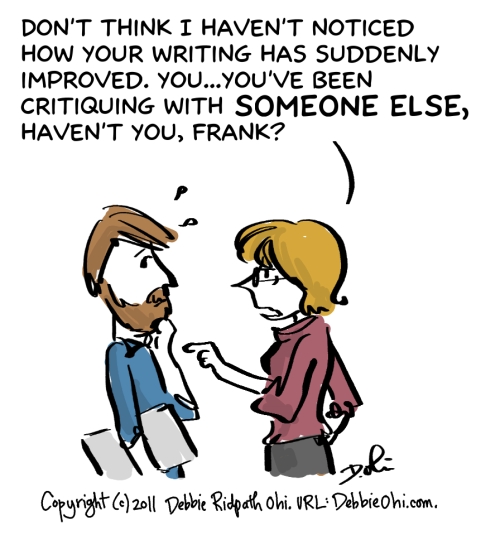
Image courtesy of InkyGirl.com

Finally, even when you do your part of valuing this critiquer, constructively criticizing, respecting their art as your own – do not cater to their perception of you. This is the part where you can hate them for hating your story. You are the writer, not them: you can keep or discard any advice you choose.

I want my students to like me, but I am in the one in control of this classroom. If they complain, “I don’t like homework”, I don’t throw away assignments and set fire to the yearly assessments and toss out candy like it’s a parade. I tell them, “Well, I don’t like you failing my class.” When I come to my students with as much kindness, compassion, and willingness to help as I can muster, and they meet me with negative attitudes, I am 100% confident that their shitty work is not my fault.

If a critiquing partner will not give your art the time of day even when you pain over theirs, then you don’t have to critique with them again. But you will be confident that this maltreatment was no fault of your own. Besides, now you’re a nicer, more patient person. Golly jee, what a burden.


The author, Cam, performing her poem "DEFCON" inside of an art museum, July 29 2017

Two months ago,  I performed a spoken-word poem titled "DEFCON", named after our DEFCON military defense system in the United States. It was about a boy who I constantly felt at war with, struggling with our hookup past, tempestuous mental health present, and uncertain future. Each stanza escalated in passion and heartbreak as the numbers counted down from 5 to 0. By 1, I was screaming.

That was something I hadn't intended. It was a snap-decision I made during the performance, filling any breaths of silence with my echo. It was one of my best poetry performances ever, if not the best. And I felt beautiful for it afterwards - cleansed, powerful, freed from this torment.

Then, he texted me later that night. He sent me three words that unraveled every lesson my art had taught me, every ounce of independence: I miss you.

And that is the kind of blood oil that pumps through my machinery. I run on this toxic energy. My art is made of this smog. And somehow, I breathe this. It's romantic, this kind of heartbreak, this kind of pain I can transfer onto the page or onto the stage. Look at how much I have to say about the same thing again and again. Look at this solace of creating art out of misery. Look how beautifully I bleed.

Why am I a heartbreak artist? Why did a younger self live in fear of running out of heartbreak because it would mean running out of poetry? Yes, the cathartic aid of creating art out of pain is useful, necessary, glorious. But what about the same, repeating pain of boys or girls or any variation of a lover treating you like shit? Making you feel so not lovely, so opposite of glorious, like someone who is prettiest and most powerful when she is screaming about how much this hurts?

I worry that we see this substitution for therapy too often and everywhere we look. We see it portrayed in media --in TV shows, in books, in music -- as tragically beautiful. As though those words should coincide beside each other.  This art becomes our voice instead of verbalizing the problem, instead of calling it out and kicking it out. We think that this pain must merit some presence in our lives because art has such a great presence in our lives. So we skewer the two together, decide that we can't have one without the other. We air our grievances and breathe them in again, inhaling carbon dioxide. It's almost like after creating this art we hold on even tighter to the heartbreak.

I'd love to say I have some solution to this. I wish I could say that I'm not proud of DEFCON and don't still have the poem memorized, safety off, ready to fire off of my tongue, heartbreak so hot I can still taste the metal of it. I wish this poem singed him, wish my pain was an exit wound in his chest.

But it falls on deaf ears. Certainly, only others who love this kind of heartbreak can truly hear the rhythm of it. The one who it was meant for, who inspired it all, couldn't possibly see or hear it. Smog doesn't have eyes or ears.


Read the more from Cam Best on Floodmark

Photo courtesy of The Underbelly Hours  The Underbelly Hours


It doesn’t make a lick of sense. Why is prioritizing what we love so difficult to do? Normal people don’t seem to have a problem with it: if they love cooking, they’ll go to the grocery store; if they love working out, they’ve got a gym membership (and they actually use it). So why is it that any vein of artist will struggle in such an incomprehensible way? I’m not talking about the “I’ll settle for a Lean Cuisine tonight” or a “I had to skip leg-day this week”. I mean the months-long hiatus we’ll take from engaging in an activity that makes us more human. 

It’s the mechanical nature of routine, I suppose. The “block out a chunk of time for yourself to write” doesn’t come as naturally as hitting the gym after work from 6-8pm. Creating your art into a routine seems to strip the humanity away from it – routines are for getting homework done, remembering to eat, doing taxes, picking up the hypothetical kids that you do not have from soccer practice. It’s the act of prioritizing those routines above what you so frivolously care about – something that makes you happy.

My last trimester of college earlier this year included two art classes. The vague prompts and chunks of class time were what made me produce art that I otherwise wouldn’t have on my own. It made painting and drawing routines, but I don’t consider those works any less of artwork just because someone else expected me to make them.

I think, at least for me, it has to do with knowing that someone else expects me to be creative. I have this paradoxical confidence in my art and my abilities, so that when people compliment my art with a “This is gorgeous” I’ll respond with “I know, right?” I’m already very aware that I’m an artist… it’s just that “I know, right?” is easier and nicer to say than, “Finally, you noticed.”

It seems so utterly selfish to create a routine around doing something you love especially when that something is only enjoyed by you. People don’t notice my years of dedication to novels I write… which is probably why I can’t remember the last time I sat down and worked on one. I feels like feeding a black hole – the nag of “What do you have to show for it?” answered by a timid “I like it.” 

What I have to show for it is that writing saved my fucking life, and it continues to every day I turn to it for comfort. I have stronger loyalty to the people in my head whom I met when I was twelve than to most real, living people. These ghosts are always there for me, and I have the luxury of abandoning them, of abandoning myself.

And maybe it’s because that, like long-term friendships, we don’t have to touch base every day to know that we care about one another. It’s not writing for six months, then jumping back into a novel for the sake of NaNoWriMo and picking up just where you left off. For me, it’s the getting started that’s the hardest, and that’s likely the depression gripping its jaws around everything I love. And then the second hardest is the leaving. It’s losing track of time every single time I start clanking away on my keyboard, or sketching then erasing then sketching, or sweeping a canvas and breathing in those definitely-not-good-for-you fumes of oil paints. Then, it’s the ctrl s, the closed Word Document, the blowing off of eraser dust, the faucet running and caking of soap in bristles. It’s like taking a detox program. The thing is, art is a drug I cannot quit. I’ll enjoy the high and stock up when I’ve got the cash, then itch until my next fix.

  Welcome back.

Read the more from Cam Best on Floodmark

Illustration courtesy of Arthropunk
I don't tend to agree with Hemingway -- especially as a writer, most especially as a person -- but he does have words for character development that toll like a bell:

"When writing a novel, a writer should create living people; people not characters. A character is a caricature."

I think the moment that I knew that I was a writer was when I was twelve. I created characters in my head to run alongside the characters in books (what the kids these days call "fan fiction"), and the characters suddenly developed minds of their own. I drew them in sketchbooks and thought about their hobbies and decided their birthdates.

Actual photo of Cam's characters she created when twelve.

As I grew with these people in my head, they housed themselves in the corridors of my cranium, cozied up next to a failing hippocampus, walked beside me through my college campus, and voiced themselves in various ways. One boy told me that he liked Brand New when I listened to an album on a walk back to my dorm, nostalgic for an old hook-up who introduced me to the band. One girl told me that she would study to be an art therapist when she was old enough for college on my way out of the grocery store. Another boy came to me in a dream and, while I was walking to the cafeteria for breakfast, stopped me dead in my tracks just so I could know that his favorite food was ham and grilled cheese.

Creating characters is an oddly intimate, delusional relationship with people who do not exist. 

A month ago, I finished teaching my 7th graders how to create characters that are believable people. They had a series of fun (they better have found them fun, dammit) worksheets that helped with brainstorming their characters. One had them create Tweets that their protagonist would write in response to the stages of their Rising Actions. Another plastered a picture of the "What Do You Want?" scene from The Notebook and helped them develop their characters wants / goals. Another encouraged them to think of a flaw or error (a hamartia) to dissuade them from Mary Sue -like character. I've been trying to teach twelve-year-olds to create people in their heads, in their writing.

It's a strange request to expect of anyone: the ability to craft a human being out of thin air and arid imagination.

I remember the first time that I met non-writers who knew what I was talking about: actors. While I'd been involved in theatre in my high school, I solely appeared on stage for the sake of hanging lights and building platforms: the glamorous life of the techie. Such was the case in college, with barriers between techies and actors solidly cemented, until one day an actor friend explained that he carried around a notebook with him at all times in case a character spoke to him.
I couldn't believe it: someone else had characters in their heads that spoke to them at inopportune times? Someone else created music playlists to listen to, changed their interests / hobbies to fit their character, bought clothes that reminded them of their characters?

Here's the thing: if you want to create three-dimensional characters, you have to become a bit psychotic. More like a lot. You have to know the 90% oceanic icebergs of each of your people, even if your writing only reveals that 10% These people need to become your friends. Even your villains -- especially your villains. You need to be asking them those uncomfortable first Tinder date questions: where are you from? who's your celebrity crush? what do you do for work? what do you want? what do you need? who did you vote for? are you gluten free? what's your social security number? 

You need to know their speech patterns, their fidgets, their relationships with others, their deep dark secrets...

But why?

Because if you don’t, it shows. If you don’t push yourself to think of your characters beyond their interactions with their environment and interactions with others, you leave them hollow men. You have to know backstories, personalities, wants, and needs in order to know character motivation, in order to know why and how your characters interact with others and their environment. 

Let me close with one last example: currently, I’m working with an actress on a film project, and her character wears an excessive amount of bracelets that purchased while traveling. When I wrote this character in my film script, I thought that it would just be a weird quirk. Now, it’s so much more: my actress thinks that her character engaged briefly in self-harm and uses the bracelets to cover her arms, and my actress is coming up with a story for every single one of the bracelets. Will the audience ever know these details? No. But by knowing her character to this degree, my actress will personally feel the biting sting when a cute boy calling her bracelets “tacky”. She is bringing my flat depiction to life. She is making this character a living person.

How will you do the same for your own characters?


Read the more from Cam Best on Floodmark.


There’s a story inside of you crying to get out… but you don’t know how it wants to speak. Does it want the fragmented barking of poetry? The snapping back-and-forth of a play or a screenplay? The roar of prose? The snack of flash-fiction? 
You’ve bitten off more than you can chew - you’re sure of it this time.
When you become a writer of various platforms, part of the labor is deciding which way to share a story. I’ve dabbled with all of the previously mentioned genres, and no doubt there are more to try. But how do you know which fits best?

Well, it entirely depends on what you have to say.


The simplest route is to write, of course. Write without pausing to paragraph break or indent a line… maybe without even punctuation. Christen yourself Faulkner and run like The Sound and the Fury that you are. [Run Ons, Faulkner, Run Ons!] 

Photoshop courtesy of Cam Best.

Sometimes, the writing will find its voice: it will shout “Poetry!” or “Prose!” or the like, and you’ll be able to start revising.
Other times might not be so lucky…

Should that be the case, what I’ll do is let the words stew. Write until the words fail you, then put your laptop or notebook on the stove burner and cover it with a lid … 

Please don’t actually do that.

When you’ve left it alone for long enough, reread it. If no format jumps out to you, now is the time to brandish your axes.
Hack off the legs of dialogue. Sever the toes of dialogue tags. Cut up the character description, the scenic description, the character actions, the environmental actions! Dismember the bastard!

Now what do you see?

If your story’s instinct is to drive forward with dialogue, you’ve likely got a play or screenplay on your hands. I find that both formats allow me to create more “raw” dialogue that doesn’t need to be cushioned and supported with the bra of character and scenic descriptions. It is all natural. The story speaks for itself [get it?] 

Telling the two apart is tricky. WIth my screenplay experience, I feel much more protective over the characters. I want to describe their backstories, I’m already specifically visualizing the story…  I allow myself to be much more creative in my scene directions in screenplays because I often direct my own film projects and laugh at my own jokes.  As for plays, to me, those scene directions manifest as instructions for movement. 

My screenplays also have much shorter, episodic scenes; my plays are typically one setting, one scene. Of course, my style for plays isn’t the same as yours, so take a look at your own writing to identify those distinguishing features.

If your story’s instinct is on character description and evolution, it might focus more towards prose
Dialogue might trip you up in this -- it might be necessary to first distinguish between spoken dialogue and internal dialogue. A paragraph heavy with spoken dialogue could suggest a play… a paragraph heavy with internal dialogue suggests prose. Prose tends to boast character more than the others, whereas characters in plays tend to… play nicely with others [my puns are on fire today. Or, as the kids say, lit. Imagine: lit literature… Lit lit!]
Prose allows for layers to unfold over and over for the reader, whereas plays are filtered through the director’s lens and displayed to the spectator. With your audience in mind, prose encourages frequent revisiting, tasting the various spices in a dish. But no platform encourages reinterpretation more frequently than poetry.

Poetry is more than eager to roast the other platforms. It certainly would never stoop so low as to dialogue! And character development? Why, only if your childhood memorabilia of a music box in the deceptive shape of a trombone is a character… 
My own poetry likes to boast its way into epic stories, blending spoken word poetry with traditional. So when I’m trying to decide if I want a poem to read for three minutes into a microphone versus thirty seconds into an ezine, I have to decide how complete my story will be. Traditional poetry will focus on snapshot moments and contain more blank space than blank verse. Spoken word will tell a story in a manner far different from prose, varying in various components. My spoken word poetry focuses greatly on sound: alliteration, assonance, consonance, you name it. It must be heard out loud. But it has a greater spectrum of emotions in those five hundred or so words, more than a short story or piece of flash fiction would reasonably have. Believe it or not, spoken poetry’s voice isn’t just a scream into a microphone.

There are many elements of writing to consider when selecting a genre: character presence, environmental presence, emotional variation, brevity of the moment of the story, dialogue… Experiment with different formats until you find your piece’s voice, for it will speak.


Flow chart courtesy of Cam Best.


Read more of Cam's work on Floodmark.


Hosting a dinner party with literary geniuses as guests sounds like a dream come true… discovering that they’re all getting killed off one by one is more of a nightmare, but exactly the case for Edgar Allen Poe’s Murder Mystery Dinner Party. This YouTube series, created by Shipwrecked, started as a Kickstarter project back in February 2016, and its season finale aired on Halloween. So you can venture a guess as to what I was doing on All Hallow’s Eve…

(source)


The Persaud siblings started their characterizations as Edgar Allen Poe (Sean Persaud) and Lenore the Lady Ghost (Sinead Persaud) in their series A Tell-Tale Vlog. Somehow, despite Poe’s severe social awkwardness, he has managed to invite authors such as Ernest Hemingway (Joey Richter), Oscar Wilde (Tom DeTrinis), Charlotte Brontë (Ashley Clements), and… Emma Dickens (Sarah Grace Hart) or whoever. Of course, a murder mystery party wouldn’t be complete without Constables Jim and Jimmy (Jim O’Heir of Parks and Recreation, and Jimmy Wong) checking in on the mayhem.

This web series has got to be one of the dweebiest, most wonderful concepts I’ve encountered in my life. Literature typically is limited to the page, but seeing appreciation for literary artists on the screen is almost too much to bear. It’s hard to imagine, at times, that there are other people out there who are equally obsessed with books and authors and poetry. This series is a sort of fan-fiction of the authors, imagining how writers and poets would have interacted with their contemporaries. It’s like Midnight in Paris, except it’s actually good.

The episodes are chocked full with literary references, terrible puns (my favorite), boisterous comedy, and drama. While watching the series with friends, we definitely were kept in suspense ‘til the very end, unsure if new characters would make appearances, or if deceased characters were truly dead. If I had to pick a favorite, I would say that the rugged alcoholic Hemingway would be it (that’s probably the first and only time I will compliment Hemingway)
The location is extravagant and absolutely perfect. The costumes and hair are beautiful period pieces. The color edit to the film gives it an eerie candlelit ambiance. The music is a subtle but strong foundation to the story. The actors are obviously dedicated to their roles, and I can barely imagine them outside of character.

After watching Mary Kate Wiles’s (Annabel Lee) behind-the-scenes video in which she vlogs about the YouTube series, it’s easy to forget that this was an indie production. The budget was only $72,141, and when taking into account all of the actors, the location, the crew, and many other fine details, this is an amazing feat.  As someone who works with an out-of-my-own-pocket budget for my own films, who works with actors around their college class schedules, I’m in awe of how dedicatedly this production worked towards their passion project.

I really do feel like this web series is a staple for the online literary community – as big as the first person who decided that they were going to vlog about books they recently read. The series deserves so much more love and support than what it currently has. My hope is that you’ll watch the first episode and follow the series through to the end, appreciating the representations of our beloved eighteen hundreds artists and the production team who created them.


Watch the first episode:


© Floodmark Made By Underline Designs