Showing posts with label Writer's Resource Review. Show all posts
I loved and still love a certain type of fantasy novel - that kind of used-bookstore paperback, musty in odor, with a distinct, epic and painterly cover illustration. Even if you haven't read one, you'd likely recognize one immediately, and surmise correctly that its pages contain tales of dragon-slaying, world-saving, maiden-rescuing, swash-bucking, and adventuring.

And almost always, maps. Behind the front cover of one of these novels, you were sure to find a black and white hand-drawn map of the story's setting. These books taught me that a good fantasy story needs a good map. The maps hooked readers, showing unknown worlds waiting to be filled by the novel. Sometimes the maps themselves were better than the following story, even!

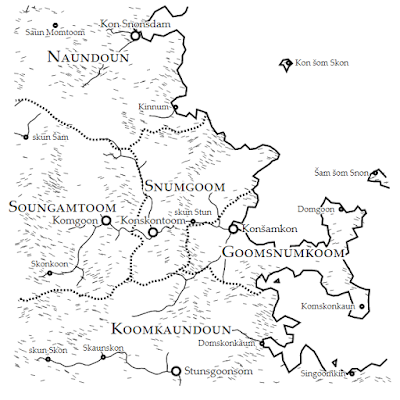
Map Created by Martin O'Leary's using his Fantasy Map Generator
It was this exact sentiment that led creative coder Martin O'Leary to create his Fantasy Map Generator. "I always had a fascination with these imagined worlds," he writes,"Which were often much more interesting than whatever luke-warm sub-Tolkien tale they were attached to."


The generator can produce random, finished maps at the click of a button. Many of maps produced this can be found on O'Leary's Uncharted Atlas twitter feed. If use the generator, though, and you want more control over what your fantasy looks like, you have options. You can shape your bodies of land through the "add slope", "add cone", "add inverted cone", and "add 5 blobs" options. You can exercise further control over your map by changing sea level and dictating erosion rates. In this way, the Fantasy Map Generator can produce a map that fits your story.


The site also give you the option to add cities and even generates names for the places on your map. This part of the map-generating process provides the greatest strength and greatest shortcoming of the generator. On one hand, the randomly generated names have a consistent feel, thus avoiding the laughable Aerith and Bob trope. On the other hand, the names are distributed in a restrictive way. Every city placed on the map is named, but the generator will only generate 5 area names, which always coincide with the first 5 cities placed on the map. Writers who want more than 5 areas or who want names for mountain ranges, islands, rivers, peninsulas, or other landforms may want to run the generator multiple times, use O'Leary's Name Generator, or even just come up with names themselves.


Naturally, such a generator should not be a crutch. As a writing tool, Martin O'Leary's Fantasy Map Generator is a good place to start, but the nature of the world your randomly generated map depicts is up to you. O'Leary even invites courageous compauthors to take a look at his code and try modifying the generator to their liking. Personally, I'm tempted to try and rectify the limitations mentioned above (stay tuned and see if anything comes of it).

So if you are the kind of writer who loves nostalgia-inducing fantasy paperbacks, is looking for inspiration for their own fantasy novel, or just loves playing with these sort of creative tools, consider spending a few hours generating fantasy maps. Between this, Microscope, and Who The Fuck Is My DnD Character, there is no shortage of great tools for constructing a great, fun, high-fantasy narrative.

Go forth and write!


A Fractal Role-Playing Game of Epic Histories by Ben Robbins


There exist two kinds of games – the virtuosic kind and the social kind. The former serves as an expression of personal excellence, an outlet for competition, and an opportunity to watch performances by the best of the best – think chess, olympic swimming, or any other game that requires great mental or physical skill. The latter serves as a lubricant for social situations, a means to break the ice, and an opportunity compete regardless of skill level – think charades, pictionary, or any number of other party games. No game falls squarely either category – a skilled charades player can be a delight to watch, and roadside chess game regularly serve as centerpieces for informal social gatherings in places like New York and Nanjing. Many games we’re familiar with – poker comes to mind – could be played as a virtuosic game or a social game entirely based on who is playing.

source: lamemage.com/microscope


If were I to select one game to serve as my quintessential social game, my choice, without hesitation, would be the game Microscope, created by Ben Robbins and published by Lame Mage Productions in 2011. I discovered it when my friend Bobor, who introduced me to such other nerdy pursuits as Dungeons & Dragons, Magic: The Gathering, and Starcraft, called me up one day to say he had found the perfect role-playing game. 

“There’s no game master though,” he said, “There’s no dice rolling. There’s no creating a character ahead of time. It’s all story-driven and the story is non-linear.”

The non-linear structure makes Microscope the perfect collaborative storytelling game. How many times have you played that pass-the-flashlight scary story game and how many times has it gone off the rails? Perhaps it would be better to ask, how many times hasn’t it gone off the rails? By eliminating the tedious “what happens next?” question, Microscope frees up the players to be a lot more creative.

I had to see how this game worked for myself so Bobor, myself, and our friend Eric set up our own game of Microscope. All we needed to play was a stack of notecards (or post-its), the three of us (two people is too few, five is too many), and the willingness to tell a story with an enormous scope.

The enormous scope is necessary because the game divides up time into periods, events, and scenes. We decided to tell the story of a family named Canéfex and began by identifying the opening and closing time periods of our story (which we called, “Canéfex family immigrates to a new land” and “Canéfex royals forced into exile”, respectively). From there, we filled in the space between with intervening time periods (e.g., “The Canéfex Family Rises to a position of power”) and nested each period with events (e.g., “Beatrice Canéfex communicates with the ghost of her late grandfather) and each event with scenes (e.g., “What transpired at the trial of the murderer of Alfred Canéfex?”). By the time the three of us decided that we were satisfied with our story, the table looked like the bizarre ramblings of some kind of conspiracy theorist, with period cards arranged in a row, event cards arranged in columns underneath, and scene cards tucked surreptitiously under the event cards. 


source: lamemage.com/microscope


While players work together to decide the theme of the story, the elements that can or cannot be included, and work together to act out each scene, during each round of play, players decide the contents of periods and events unilaterally. This is a huge strength of Microscope – there is no storytelling by committee, everyone just has to act and react as the story unfolds. And this is an added benefit of the non-linear style; if you don’t like the way the story is headed, just push all the cards an inch to the side and add a new intervening period or event.

One of the limitations, however, is that Microscope does not lend itself to telling small, personal, or intimate stories. A story may span up to a dozen periods, and it is a good rule of thumb that any named character in a period must die before the beginning of the next period. As a result, the lives of characters become subordinate to the epic march of history.

Microscope is a perfect game for writers. We’re normally a pretty reserved lot (yours truly notwithstanding) so we often need a social game to get us out of our shells. Moreover, Microscope provides a way for writers to interact while flexing their writerly skills. It’s a collaborative storytelling structure that encourages an fantastic level of imagination in all its players. If I have been vague about the mode of play, it’s because I want to encourage you to actually read Ben Robbin’s work which can be found at lamemage.com/microscope. Take a look, give it a try, and may it provide a social stimulus for you and your writerly group of friends.


Read more of Vernon's work on Floodmark.


With writing schedules packed full of research, drafting, and revising short stories, poems, and novels, it’s easy to neglect perhaps the most important skill: getting started. I’m among those writers who normally bum around in life until inspiration hits them between the eyes and they hit the ground running, no stretching beforehand.

Tell any athlete to just play a game of sport ball while expecting them to win all the points without warming up, and they’d understandably laugh in your face (I’m assuming this, on account of I don’t associate myself with people who willingly sweat for fun. They don’t find me all that exhilarating either).

Artists need to warm up beforehand just as much as athletes do. The brain is a muscle too, and we’ve got to stretch it (though gym teachers don’t exactly equate hard thinking to hard workouts, much to my dismay) And if we don’t know how to start writing, we’ll struggle more when we don’t know what to write about. The dreaded Writer’s Block will strike again, and we will be slave to this dark, soul-sucking obstacle.

So wouldn’t you know that I was on my lazy ass browsing through Facebook, when I saw that my friend had tagged me in a post advertising a writing app. This app is called The Most Dangerous Writing App. Aptly named, The Most Dangerous Writing App demands that writers write for a continuous period of time without stopping… or else all their work is deleted.

Deleting a writer’s work is arguably up there on the list of Horrendous Things to Do, next to “hitting someone’s dog with your car” and “castration”. It’s the stuff of nightmares. Creator Manuel Ebert comments that “ ‘tis better to have written and lost, than never to have written at all” in the Help section of the app, which nearly motivates me to hypothetically delete any Microsoft Word documents on his laptop and see what he says after that.

But here’s the thing: no one is asking you to pen the next Wasteland in this app. No one’s stopping you from writing “John Tucker must die” 100+ times just to get that word count. But here’s a suggestion on how to find a happy medium between creating a masterpiece and copying monotonous nonsense. 

With this in mind (and not nearly enough alcohol in the stomach) I decided to give the app a try. I started off with 5:00 on the clock and practiced writing down whatever came to my head. I found that while I was writing, I instinctively wanted to slow down or stop writing. I’m used to taking a fraction of a pause, often to find the right word I’m looking for or to further formulate an idea before jotting it down. The app forced me to be reactive and–just as Ebert notes – “shut down [my] inner editor”.

For my second go at the app, I turned on hardcore mode and settled on writing for 5:00 about a topic I knew about. I expected this round to be much more difficult, since I would have to actually make sense. I still found that I completely lost my typical writer’s voice – I was writing the way that I speak, which is very informal and rambling. I’d also learned that ‘hardcore mode’ meant that none of the writing would be visible: you’re able to see one letter at a time, which can almost make you forget what word you’re writing. Gods forbid it’s “supercalifragilisticexpialidocious”.


Let’s look at a breakdown of biggest pros & cons for the app:

PROS: 

  • break through your writer’s block – write about anything that comes to mind, transition into any topic
  • increase typing speed
  • forces writer to complete designated time to solely writing

CONS: 


  • hard to stay on topic or have writing seem coherent –feels like throwaway writing
  • focus is on quantity, not quality
  • hardcore mode breaks down the writing process into such small pieces that words feel more like letters – feels too removed from idea-generation portion of writing process


Considering that I was initially against using this writing app, I’m glad that I gave it a try. It’s a useful tool for the kind of writer who struggles to get their fingers moving, who feels so much pressure on getting the exact words and ideas down on the first try; I don’t necessarily think that this is the best app out there for helping to generate ideas on what to write about. Still, The Most Dangerous Writing App is definitely something to consider adding to your writing arsenal.

IN ACTION: 


Round 1 (5:00)


Round 2 (5:00 hardcore)


Read more of Cam's work on Floodmark here.


Greetings, poets! Today, we're doing something a little different. Instead of providing you with another short and sweet writing prompt like we do on most Tuesdays, we're going to review a writing resource you might not know about, but should.

If you've been writing for any length of time, you probably recognize that getting feedback on your poems in an imperative part of becoming a better writer, but getting that feedback isn't always easy. Once you leave the undergraduate nest and all of your fellow writers have also flown the coop into all parts of the country, it can be tricky to snag some constructive criticism when you want an opinion on a poem. Luckily, there's a new online resource for that: WritingFloor.com.

WritingFloor is a place where writers can share their writers in hopes of receiving feedback; similarly, you can generate some constructive criticism karma and leave a note or two on someone else's poem. Ultimately, WritingFloor is a community for writers, much like your friendly neighborhood Floodmark blog.

source
WritingFloor: a community for creative writers

What I like about WritingFloor is that it's not complicated at all. Simply plug your poem into the WYSIWYG editor, and you're done! Of course, to get the most out of writing floor, you have the option to select up to five different questions to help narrow down the feedback you want to receive. Do you just want general feedback? Great! You can ask readers to leave their general impressions. Want to know how your line breaks look to someone else's eyes? Just ask! The questions are broad enough that you should be able to get intuitive feedback, even though you can only select five.

You can also select different categories to help your poem get found by other readers. You can categorize your poem into different themes, schools of thought, genres, or moods to attract people looking to read a specific kind of poem. On the flip side, you can use the categories on WritingFloor to expose yourself to different kinds of poems you might not normally pick up. Been reading lots of romance, for example? You can shake things up a bit by reading some poems about capitalism. By critiquing work in a different vein than what you're used to, you give yourself more breadth as a writer.

Now, my personal experience with WritingFloor is still a story waiting to unfold. I recently submitted the poem that came from my line by line writing experiment, and I got a comment within 24 hours, which was great to see. I'm hoping that my questions (I selected What are your general thoughts about this poem?, How does the line arrangement affect the meaning of the poem?, and How would you describe the poem's speaker? for my questions) will generate some interesting feedback that will help me transform my Franken-poem into something not quite so restricted. (Pssst want to follow along with the feedback I'm given? Check me out on WritingFloor.)

All in all, I encourage each and every one of you dear readers to take a peek at WritingFloor and make some new poetry friends. It's still relatively new (it was founded in 2014, just like us!), and I can't wait to see how it grows as an online community. Why not be part of the movement?

I did not receive any compensation to write this post. All opinions are 100% my own. Thanks for reading!


© Floodmark Made By Underline Designs