Showing posts with label Food for Thought. Show all posts
We recently asked a number of writers to nominate a cultural phenomenon as "the great American novel", with the caveat that the were not allowed to nominate an actual novel. This nomination comes from the fantastic Mitchell Blatt -- The Editors


Everyone between the ages of 20 and 47 knows the story of Poop Head and his tragic journey West. When I was asked to nominate my choice for the Great American Novel, I couldn’t help but think of him constantly shitting liquid for days on end. Half the company had already died when the wagon flipped over while crossing the Green River, and the rest were near starving, since they had spend all their ammo killing 4,000 pounds of buffalo in Kansas, but they could only carry 100 pounds back. They had survived by pillaging abandoned wagons and became so good at finding supplies that some even wondered how “abandoned” the wagons really were when they first came upon them. Ole Poop Head was optimistic til the end. He was really hanging in there and could almost see the border of Oregon in front of him. But it was not to be. He died of dysentery just after Fort Boise. Of course the Banker from Boston had to continue immediately without providing a proper burial. It is in these themes of life and death, of greed for wondrous riches tempted by the reality that most will never make it, that make this a hallmark of the nation’s spirit. I am speaking, of course, of The Oregon Trail. 


It was a simpler time then, a time of innocence and naivety, when we thought new technologies could unleash education upon the masses, rather than dumbing us down and stealing our personal information in order to facilitate the election of a half-literate demagogue.


Mitchell Blatt is a masters candidate at the Johns Hopkins' School of Advanced International Studies. He is the author of Panda Guides: Hong Kong and editor of Bombs + Dollars. His work has additionally appeared in National Interest, Areo Magazine, Roads & Kingdoms, Korea Times, and Acculturated.
We recently asked a number of writers to nominate a cultural phenomenon as "the great American novel", with the caveat that the were not allowed to nominate an actual novel. This nomination comes from the terrific Nathan McDowell -- The Editors


THE GREAT AMERICAN NOVEL IS OLD PEOPLE MEMES ON FACEBOOK.  I KNOW YOU TYPE LIKE THIS BECAUSE UPPER CASE LETTERS ARE EASIER FOR YOU TO READ, MARYAM.  I ASSUME THAT YOU'RE ALSO HARD OF HEARING, SO I LOVE READING YOUR POSTS AS IF YOU'RE YELLING THEM.  THAT IS TO SAY YOUR SELF-EXPRESSION HAS A VARIETY OF INTERPRETATIONS AND THEY'RE ALL BEAUTIFUL.  YOUR STRUGGLE IS PERFECT IN IT'S PROSAICNESS AND IT'S DEPTH.  YOU ARE THE ANTIDOTE TO THE NEUROSES AND POSTURING THAT IS KILLING ME AND ALL MY FRIENDS.  YOUR SINCERITY IS NOT DECONSTRUCTABLE, IT IS MORE PURE THAN THE CHILDHOOD MEMORIES I DARE NOT UTTER HERE.  WHO COULD POSSIBLY POST SO MANY MINION MEMES AND GIFS SHARED IN A VIDEO FORMAT, IF THEY WERE NOT AS SELF-ACTUALIZED AS YOU.  PEOPLE SPEND LONG HARD HOURS TRYING TO CAPTURE SOMETHING YOU EXPRESS EFFORTLESSLY BETWEEN JEOPARDY AND COOKING DINNER


Nathan McDowell is a poet from Rock Island, IL who's work can be found in publications such as Buffalo Carp and Off Channel.  When he was younger he was convinced that old people were ruining Facebook, but it's now become very clear to him that they've saved it.
I spent fifteen minutes of a twenty minute grocery trip in the liquor aisles tonight. I seldom drank in college, but the four months I've spent at my first job are tombstone-marked by empty bottles beside the end table in my bedroom. These aren't the only bottles keeping track of me.
I've been taking anti-depressants for almost seven months, and let's be clear that mixing SSRIs with alcohol once a week, or three days in a row, or any increment of time other than "intermittently" packs a suckerpunch of health risks. There's something very Beatnik about mixing prescription drugs with alcohol.
Clockwise from top left, skeletal diagrams of the neurotransmitters serotonin, dopamine, norepinephrine, and epinephrine. Diagrams from Wikimedia Commons.

I hate the Beatniks.

There's always been a bad taste in my mouth when I read writing inspired by someone's drug use. I don't regard my art as my own if taking a substance that modifies me is to take credit for my creativity. There's a lot to do with intent behind it: I don't agree with choosing to take some mind-altering substance in order to create art. It feels cheap to me -- like, what, you weren't creative enough on your own? Steroids build muscle and water is wet -- you just don't have enough of a drive or the skills or the talent to succeed the God blessed American way through hard work and tenacity.

To me, artwork inspired by and promoting drug use isn't something with which I connect. I guess Bush's War on Drugs really did succeed - thanks, D.A.R.E.

During my teen years, I mentally cautioned myself against getting mixed up in drugs --whether they were hard, soft, smoked, injected, cheap, expensive. I knew that, as an artist, I had an addictive personality, and substances are typically, you know, addictive.
Now, I've found myself using alcohol to fall asleep, or to feel happy and carefree for once. It's even inspired a poem for me.

Because I've been using SSRIs and alcohol to cope through this depressive period, I decided to try a style of poetry I was first introduced to by our loving and lovely leader, Alli. The form is a palindrome: a poem that can be read forwards and backwards, producing two meanings or stories from one form. It's a BOGO deal! Some common palindrome words or phrases are racecar, borrow or rob? , or red rum, sir, is murder.
I regret to inform you that "palindrome" is not a palindrome.

Damn Beatniks. Photo courtesy of The Onion

Though the poem itself was about alcohol, the difficulty of crafting a palindrome required sobriety. This kind of inspiration from alcohol seems a bit ass-backwards and atypical, though, and a choice of which I think the Beatniks wouldn't be too fond. I don't know if I'd be open to appreciating artwork inspired by someone's drug use, though the concept has crept into my own life in an unexpected way. It's definitely something I need more exposure to and consideration of.

--Cam


I used to play in a band with a friend who referred to cannabis as "green inspiration", the implication not only being that was inspiration something that he could turn on and off through his consumption of marijuana, but that inspiration would not come unless he smoked. In this way, he used art-making as a way to excuse a frankly disgusting habit.

On one hand, I resent artists who lean on mood-altering substances of any type for inspiration, if only because it impedes collaboration. As a songwriter and a former bandleader, I have had to wrangle musicians who have shown up to performances or recording sessions lit up like a pinball machine, stoned out of their gourds, rolling down paradise parkway, monkey tripping, candy flipping, or good old-fashioned drunk. These incidents almost always resulted in my best impression of J.K. Simmons' Dr Fletcher from Whiplash.

On he other hand, while keeping in mind that mood-altering substances should never be a crutch, I nevertheless support the idea that they provide crucial supports in the creative process and in living. We all do drugs, in one way or another. But please do not misunderstand me - by "drugs" I do not strictly mean "controlled substances" or "psychedelics" or "uppers and downers". We all have some sort of habit, either regular or irregular, that we use to regulate our moods and support ourselves in our creative lives. Philosopher Alain de Botton has cited, in his School of Life videos, that his drug of choice is, based on this definition, emmental cheese.

Increasingly, I have become interested in what drug use means as a wider social phenomenon. My generation is one that came of age between years of peak methamphetamine and cocaine overdose deaths (2007) and peak opioid overdose (2016, but perhaps 2017 or 2018). What are we to make of that? My generation has embraced the use of adderall and microdose LSD in order to maximize productivity. What are we to make of that? My generation holds a generally positive opinion regarding the use of magic mushrooms, ecstasy, and ayahuasca in mental health treatments, or even for "spiritual healing". What are we to make of that?

From the National Institute on Drug Abuse

Making sense of large-scale drug use trends usually means talking to drug enthusiasts, which has invariably led to some of the most frustratingly circuitous conversations of my life. Broadly speaking, drug users I have spoken to fall into one of three camps: supplementers, brain hackers, and oblivion seekers. Supplementers see drugs like cannabis, adderall, or microdose LSD as harmless supplements they can take to improve their day-to-day lives. These drug users see drugs as room for personal improvement, making them less anxious, more productive, more perceptive, or more outgoing. Brain hackers see the human mind as something than can be radically altered for the better by entheogens or psychedelics. They might be simply more intense supplementers, but more frequently they carry utopian visions - think Timothy Leary, Huxley's Doors of Perception, or Tao Lin's upcoming Trip - that radically from simpler self-improvement goals.

The benefits of brain hacking, from Tao Lin

The oblivion seeking mode of drug use, in my mind, represents the Thanatos to the other modes' Eros. A drinker looking to black out is an oblivion seeker, as is an individual who seeks out opioids, benzodiazepines, or other drugs that slow and mind and numb sensation. True, the current opioid crisis is due in large part to the greed of the Sackler pharmaceutical family and the flaws of the American healthcare system, but do what degree did these drugs satisfy a preexisting, Freudian death-drive? I don't have an answer to that. Not yet, at least.

--Vernon


It is a founding principle for old and new teachers alike: do not care whether your students like you or not. Easier said than done when you’re just a sucker with no self-esteem.

But teachers have bigger problems to worry about: if you’re going to be fired because your test scores weren’t high enough, differentiating instruction, student attendance, cantankerous parents, Betsy “Satan’s left testicle” DeVos. You’re not in middle school anymore – you’re teaching middle school. You don’t need a good reputation with twelve-year-olds.


Right?

Image Courtesy of Wikimedia Commons


            Wrong, you dork.


            Alright, so I’m only four months into my first ever teaching job, so I don’t exactly have years of experience or Noble-prize winning academic articles defending the importance of positive relationship building with students. But I do have ninety kids, twenty five of which are eighth graders, so I know a thing or two about getting some to sometimes shut up and listen to me.

            And if you’re looking to build a critique relationship with someone about your artwork or your literature, you’ve also gotta know how to get them to sometimes shut up and sometimes listen.

            So what does liking / benefiting from each other look like? Well, it requires mutual respect, personal investment, gains for both parties, and constructive feedback.


            1. Mutual Respect: They are not Your Peasant. Let’s get one thing straight: your planning is bullshit. Having specific requirements on what your critique partner should notice, offer comments on, etc. overlooks the very human aspect of communication and reactions.

As a teacher, I know that I have to bend to students if I don’t want them to snap. When we think about this in artistic criticism, we need to think about what this bending looks like. I want to see what people bring to the table: what can I learn from their unique perspective? Even if you’re dead certain that you know more than them or have greater experience on your side, “throwaway” critiquers can show you what misinterpretations of your art might look like. Maybe this critiquer doesn’t know jack about your brief historical blog post about the history of Colby Jack cheese, but she does know a lot about grammar… your arch nemesis.

You are no ruler of all things: don’t require critiquers to “measure up” to receive the sheer glory of contact with your art.


2. You are a Guest in Their House: Respect the furniture that is their world-building. Do not knock over the Ming Dynasty vase of their protagonist’s tragic backstory. Wipe off your shoes on the doormat before trekking mud over the ancient rugs of their awkwardly-choreographed fight scene.

Our art is our most precious My Precious. Say those not-nice-things nicely; focus on what can be redecorated, not gutted. You wouldn’t want someone else taking a shit in your kitchen sink, so don’t shit in theirs.


3. Appreciating an Outsider Perspective, Even if They’re Out of Their Mind: You don’t need to agree with everyone’s opinion. What you do need to do, however, is show that you value their opinion. This looks like asking clarification questions, understanding someone’s personal biases & intentions, and generally treating them like a person who has devoted a lot of time to read through every single one of your words and period marks to delve into your story. Maybe they hate your story – don’t hate them for it. Yet. Ask them “Why?”

One fantastic educator once told a TEDTalk audience something that resonated extremely deeply with me: “Speak to understand, not to be understood”

            When I say that you need to get your critiquer to shut up and listen, that goes for you, too.  Show them that you are seriously serious about anything that they have to say. If your friend is too worried about hurting your feelings & they self-censor, then that's a throwaway critique. If someone loves you enough to cut you down, maybe you should listen to it.
             So long as they actually love you. If they're being a dick for the sake of being a dick, then they're definitely a dick. Take it with a grain of salt.

4. Constructive Criticism with S.O.S : Summarize, Observe Strengths & Struggles, Strategies for Improvements. No one wants to collaborate with someone who can only find entirely positive or negative things about their writing… with no discussion.

When I’m in the long-haul for providing constructive criticism, I use a variation of the 3 S Feedback Strategy created by educator Ron Byrnes. I’ve modified the feedback strategy (to Summarize, Strengths of writing, and Suggest improvements) because, while Byrnes makes the argument to avoid dwelling on short-comings that students all too frequently hear, I believe that addressing these struggles with skills or tools to revise pinpoints where and how we improve our writing.

Summarizing a chapter or paragraph of someone’s story helps to show the writer the general impact of their passage. Listing strengths and struggles should balance a scale: as many compliments as criticisms. Finally, offering resources for how to improve these writing crimes and punishments allows your writer partner means by which to grow.


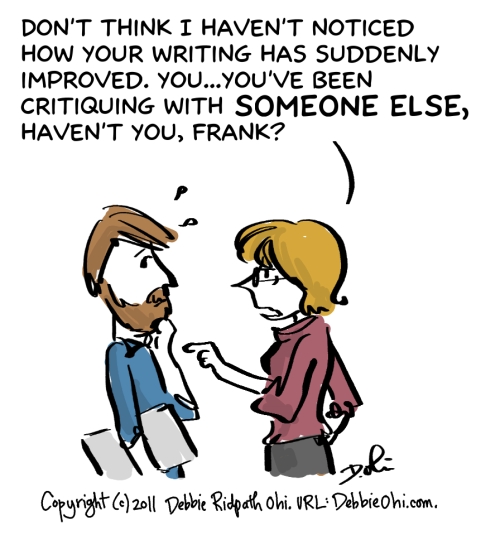
Image courtesy of InkyGirl.com

Finally, even when you do your part of valuing this critiquer, constructively criticizing, respecting their art as your own – do not cater to their perception of you. This is the part where you can hate them for hating your story. You are the writer, not them: you can keep or discard any advice you choose.

I want my students to like me, but I am in the one in control of this classroom. If they complain, “I don’t like homework”, I don’t throw away assignments and set fire to the yearly assessments and toss out candy like it’s a parade. I tell them, “Well, I don’t like you failing my class.” When I come to my students with as much kindness, compassion, and willingness to help as I can muster, and they meet me with negative attitudes, I am 100% confident that their shitty work is not my fault.

If a critiquing partner will not give your art the time of day even when you pain over theirs, then you don’t have to critique with them again. But you will be confident that this maltreatment was no fault of your own. Besides, now you’re a nicer, more patient person. Golly jee, what a burden.


After merely skimming the title of Joan Didion’s “Marrying Absurd,” not knowing it was an essay about shotgun weddings, I thought to myself, I want to marry absurd. 

Because I want to marry Shia LaBeouf. 


Okay, so this is a very outdated meme. But there’s something artistic about absurdity. The production value combined with the composure of all those involved in this work of art is something to be called into question. Many talented people got together and choreographed the dancing and acrobatics, learned the routine, composed music, arranged music, wrote lyrics, sang like angels, crafted each paper mache Shia LaBeouf heads… the list goes on. The production value alone is enough to make you question is it really a giant joke? Not to say that you shouldn’t go far, way too far, and be way too serious about your humor.

The whole concept reminds me of my dog, mustache tousled, beady eyes ablaze, digging furiously into his plastic crate. He isn’t going to move any dirt. There’s no dirt to move and the plastic isn’t going to budge. But through his poignancies, his determination, he makes me laugh. Imagine my dog is Schnauzer LaBeouf.

The more seriously you take your humor, the more relentlessly you imagine it, the more likely you are to crack yourself up. And maybe others too. Or they’ll just think you’re ridiculous. But doesn’t the very idea of other people thinking you ridiculous, of looking on in disbelief funny itself? 

Imagine this. You are sitting at your desk job and someone slams a 20-pound malted milk ball next to you and begins to gnaw on it. At first, you hear the squelch of melting chocolate; feel the coolness of previously refrigerated shavings flying onto your arm from the point of chewing. Then, as your co-worker reaches the wafer level, and sound becomes airy on his teeth, and crumbs hot, spittle more frantic. Your workstation is ruined. There is saliva and chocolate permeating your keyboard. Your productivity is ruined. Imagine this co-worker is Snack-sinner LaBeouf. 

Source

Write manic.

The more vivid and impassioned the humor, the more absurd, the more attracted I am to it. Hence, I want to marry Shia LaBeouf. My mom doesn’t like that.


It doesn’t make a lick of sense. Why is prioritizing what we love so difficult to do? Normal people don’t seem to have a problem with it: if they love cooking, they’ll go to the grocery store; if they love working out, they’ve got a gym membership (and they actually use it). So why is it that any vein of artist will struggle in such an incomprehensible way? I’m not talking about the “I’ll settle for a Lean Cuisine tonight” or a “I had to skip leg-day this week”. I mean the months-long hiatus we’ll take from engaging in an activity that makes us more human. 

It’s the mechanical nature of routine, I suppose. The “block out a chunk of time for yourself to write” doesn’t come as naturally as hitting the gym after work from 6-8pm. Creating your art into a routine seems to strip the humanity away from it – routines are for getting homework done, remembering to eat, doing taxes, picking up the hypothetical kids that you do not have from soccer practice. It’s the act of prioritizing those routines above what you so frivolously care about – something that makes you happy.

My last trimester of college earlier this year included two art classes. The vague prompts and chunks of class time were what made me produce art that I otherwise wouldn’t have on my own. It made painting and drawing routines, but I don’t consider those works any less of artwork just because someone else expected me to make them.

I think, at least for me, it has to do with knowing that someone else expects me to be creative. I have this paradoxical confidence in my art and my abilities, so that when people compliment my art with a “This is gorgeous” I’ll respond with “I know, right?” I’m already very aware that I’m an artist… it’s just that “I know, right?” is easier and nicer to say than, “Finally, you noticed.”

It seems so utterly selfish to create a routine around doing something you love especially when that something is only enjoyed by you. People don’t notice my years of dedication to novels I write… which is probably why I can’t remember the last time I sat down and worked on one. I feels like feeding a black hole – the nag of “What do you have to show for it?” answered by a timid “I like it.” 

What I have to show for it is that writing saved my fucking life, and it continues to every day I turn to it for comfort. I have stronger loyalty to the people in my head whom I met when I was twelve than to most real, living people. These ghosts are always there for me, and I have the luxury of abandoning them, of abandoning myself.

And maybe it’s because that, like long-term friendships, we don’t have to touch base every day to know that we care about one another. It’s not writing for six months, then jumping back into a novel for the sake of NaNoWriMo and picking up just where you left off. For me, it’s the getting started that’s the hardest, and that’s likely the depression gripping its jaws around everything I love. And then the second hardest is the leaving. It’s losing track of time every single time I start clanking away on my keyboard, or sketching then erasing then sketching, or sweeping a canvas and breathing in those definitely-not-good-for-you fumes of oil paints. Then, it’s the ctrl s, the closed Word Document, the blowing off of eraser dust, the faucet running and caking of soap in bristles. It’s like taking a detox program. The thing is, art is a drug I cannot quit. I’ll enjoy the high and stock up when I’ve got the cash, then itch until my next fix.

  Welcome back.

Read the more from Cam Best on Floodmark

Illustration courtesy of Arthropunk
I don't tend to agree with Hemingway -- especially as a writer, most especially as a person -- but he does have words for character development that toll like a bell:

"When writing a novel, a writer should create living people; people not characters. A character is a caricature."

I think the moment that I knew that I was a writer was when I was twelve. I created characters in my head to run alongside the characters in books (what the kids these days call "fan fiction"), and the characters suddenly developed minds of their own. I drew them in sketchbooks and thought about their hobbies and decided their birthdates.

Actual photo of Cam's characters she created when twelve.

As I grew with these people in my head, they housed themselves in the corridors of my cranium, cozied up next to a failing hippocampus, walked beside me through my college campus, and voiced themselves in various ways. One boy told me that he liked Brand New when I listened to an album on a walk back to my dorm, nostalgic for an old hook-up who introduced me to the band. One girl told me that she would study to be an art therapist when she was old enough for college on my way out of the grocery store. Another boy came to me in a dream and, while I was walking to the cafeteria for breakfast, stopped me dead in my tracks just so I could know that his favorite food was ham and grilled cheese.

Creating characters is an oddly intimate, delusional relationship with people who do not exist. 

A month ago, I finished teaching my 7th graders how to create characters that are believable people. They had a series of fun (they better have found them fun, dammit) worksheets that helped with brainstorming their characters. One had them create Tweets that their protagonist would write in response to the stages of their Rising Actions. Another plastered a picture of the "What Do You Want?" scene from The Notebook and helped them develop their characters wants / goals. Another encouraged them to think of a flaw or error (a hamartia) to dissuade them from Mary Sue -like character. I've been trying to teach twelve-year-olds to create people in their heads, in their writing.

It's a strange request to expect of anyone: the ability to craft a human being out of thin air and arid imagination.

I remember the first time that I met non-writers who knew what I was talking about: actors. While I'd been involved in theatre in my high school, I solely appeared on stage for the sake of hanging lights and building platforms: the glamorous life of the techie. Such was the case in college, with barriers between techies and actors solidly cemented, until one day an actor friend explained that he carried around a notebook with him at all times in case a character spoke to him.
I couldn't believe it: someone else had characters in their heads that spoke to them at inopportune times? Someone else created music playlists to listen to, changed their interests / hobbies to fit their character, bought clothes that reminded them of their characters?

Here's the thing: if you want to create three-dimensional characters, you have to become a bit psychotic. More like a lot. You have to know the 90% oceanic icebergs of each of your people, even if your writing only reveals that 10% These people need to become your friends. Even your villains -- especially your villains. You need to be asking them those uncomfortable first Tinder date questions: where are you from? who's your celebrity crush? what do you do for work? what do you want? what do you need? who did you vote for? are you gluten free? what's your social security number? 

You need to know their speech patterns, their fidgets, their relationships with others, their deep dark secrets...

But why?

Because if you don’t, it shows. If you don’t push yourself to think of your characters beyond their interactions with their environment and interactions with others, you leave them hollow men. You have to know backstories, personalities, wants, and needs in order to know character motivation, in order to know why and how your characters interact with others and their environment. 

Let me close with one last example: currently, I’m working with an actress on a film project, and her character wears an excessive amount of bracelets that purchased while traveling. When I wrote this character in my film script, I thought that it would just be a weird quirk. Now, it’s so much more: my actress thinks that her character engaged briefly in self-harm and uses the bracelets to cover her arms, and my actress is coming up with a story for every single one of the bracelets. Will the audience ever know these details? No. But by knowing her character to this degree, my actress will personally feel the biting sting when a cute boy calling her bracelets “tacky”. She is bringing my flat depiction to life. She is making this character a living person.

How will you do the same for your own characters?


Read the more from Cam Best on Floodmark.


Hello readers, writers, dabblers, artists, and web surfers! 

I wish you all a happy, happy new year! However, for many of us, a happy 2017 seems nigh impossible given the political circumstances here in the USA. And that's partially what I want to talk to you about today: what you can expect of Floodmark in the coming years and where we stand, given the current political environment. Let's get that out of the way first, shall we? Then we can discuss the 2017 Reading Resolution Challenge, and exciting forthcoming projects.

Floodmark was founded on the idea of inclusivity, and now more than ever we are committed to it. We believe that creative writing serves everyone and should represent everyone. That means this site is a safe space for all, and we have zero tolerance for hate speech or anything that makes other readers feel unsafe. Our commitment to that is unwavering. This is a space for people from all backgrounds, ethnicities, races, genders, sexual orientations, religions, beliefs, and (of course!) writing skill levels. We welcome you to our space on the internet, and hope you will find inspiration, support, and perhaps a smile while you're here. If you ever find yourself triggered by anything on this blog, please speak out! Nobody is perfect, and we expect to make mistakes. You will find a very receptive and responsive team of editors ready to learn, make amends, correct the mistake, and be better editors and people moving forward. You can find our Contact Information here.


While we're on the subject of contact information -- if you ever have anything to talk to us about, we're around. If you want to ask "What's up?", we'll tell you what's up. If you want a book recommendation, we've got you. If you're looking for guidance or want to see something on the blog or need a friend to talk shop with, we're here. When we say "creative community", we're not just saying it. That's always been the beauty of Floodmark: we are writers, just like you, and we're on the other side of the computer. Not hiding, but waiting, writing, thinking, laughing, crying, binge-watching Netflix, eating too much sugar, and generally doing all the same things you're probably doing. So get in touch! We'd love to hear from you.

While we continue our commitment to inclusivity, we want to do more than open up our space. We intend to get more involved. (If you've got an idea for a partnership, contact us!) We started to do this in 2016, if you recall Floodmark getting into the classroom to lead creative writing workshops at Loyola University's Q-Summit and our visit to the Center on Halsted in Chicago. (You can read all about it here!) We want to do more of that. And this brings us to the 2017 Reading Resolution Challenge. We'll be seeking out the many brilliant writers who have been historically marginalized in the USA -- Native American, Black, Latinx, Asian American, Arab American, Muslim, Jewish, Hindu, Atheist, Women, LGBTQIAP+, and immigrant writers. Every month, we'll publish a round-up of writers that we've had the pleasure of reading. Share it. Send the poems to family, friends, whoever. Let these writers be heard. True, it's a small act. But when we actively seek to read outside our own experiences, or focus on finding writers who aren't being heard, we make a tiny difference. We build a bridge, brick by brick, poem by story by essay. We should celebrate our differences as well as our similarities. Diversity is what makes humanity -- and thus literature -- so beautiful. Sometimes people forget that. Let's remember it in 2017.

We challenge you to not just read these writers, but to give them your time, attention, and make room in your life for their voices. Perhaps you will disagree with some of them. All we ask is that you know why you disagree -- respectfully. The art of respectful disagreement is one that all writers and readers should be studying closely in an age where disagreements escalate so easily to violence and "otherness". And while we're on the topic: we reject the "other" in 2017. We (and you) can and will be better than this. We owe it to ourselves and everyone we share this world with not to make "others" out of people who are different from ourselves. We are all writers here. Live by the golden rule and treat each other how you'd like to be treated. We encourage you to comment on social media and/or the blog posts, send us an email, whatever is easiest. Tell us what you think.

What else can you expect in 2017? Lots of excitement and inspiration! We've got a couple projects under construction that we hope to launch by mid-year. The most exciting project we've been working is our soon-to-be self-paced, online open course called "Poetry 101". Don't be fooled by the name; poetry veterans will find things to take away from this course, too! We'll be providing video lectures, reading lists, and prompts in each module. There will be 10 modules in total, each covering what we see as the foundation of good poetry. Learn the ropes with us, or hone your craft. You can submit your poems for feedback from each other and us throughout the course. Pretty neat, right? We're hoping to launch the course in the Spring.

The Editors will also continue our monthly reading series on SoundCloud, which you can find here. Each month, we'll all select pieces (poetry, non-fiction, fiction, etc.) that fit a seasonal theme. (For example, January's theme is Winter.) We'll record ourselves reading, and pow! Story time for you. Now you can get your daily dose of poems/stories/essays while you're driving, mowing the lawn, or doing something else equally boring.

There are more things under construction, but this should give you a good idea of where Floodmark is headed in 2017. By the end of the year, we hope we'll have made an impact, and helped you get some good writing done. Stay tuned!

All the best & brightest,

Pssst, read Alexandria's other articles on Floodmark here.


I don't know how many times, in the last several weeks, I've scrolled through my Facebook feed to see a post bemoaning our President Elect's language. I'm not talking about racial slurs and grabbing pussies. I'm simply talking about his command of basic English ("bigly" and "bad hombres," anyone?).


At this point, I usually have several thoughts:
  1. Is this really the thing we need to be commenting on right now, when our future head of the EPA is vowing to fight three of our biggest climate change initiatives?
  2. This feels a little elitist, though of course the representative of this country should be able to speak its language.
  3. This "bad English" was probably a part of the connection that he made to so many people who'd never voted before.
  4. Again, why do we need to spend this much time focusing on this part of his language, instead of other, more problematic, parts?

But I also wonder what effect our diminishing vocabularies (here's an example of how many words we no longer use to describe landscape) will have on our relationships with people in the future.


I teach a composition course to first-years in college, and I find myself needing to explain why my class is more than just a gen-ed for them to suffer through before they can move on to other, more important things. The point that I land on, and one I believe is true, is that we interact with more text in our day-to-day lives now than ever before. You're reading this on the interwebs where, earlier, you might have heard it as a radio segment or seen it on TV. If you find it particularly interesting, you might text someone about it, or post it on someone's wall. All of those are text-based communications.


The thing is, most of the text we consume nowadays is functional. It's written to convey meaning as quickly and efficiently as possible, without regard for "art" or "sounding good." Frankly, that's what I teach my students–how to structure their texts and sentences so that they make sense. I give extra points for style, but we only get to style when everything else is taken care of.


What will it mean when we only write to convey meaning, when our vocabularies don'e need to include both "jump" and "leap" because doesn't "leap" just mean "jump with more effort" (for the record, Google definies jump as "push oneself off a surface and into the air by using the muscles in one's legs and feet" and leap as "jump or spring a long way, to a great height, or with great force")?

Do we really lose anything when we aggressively categorize childrens' books according to "reading level," and so remove words that are "too difficult?" When I reread the books I read as a child of 6 and 7, I'm astounded that I was reading words like astounded without having to run to a dictionary of ask my parents what they meant. I guess I just learned, early on, how to read using context clues. No one taught me how to do that. It wasn't a skill I had to learn in school. I just did it.


And, while "Just do it" doesn't work for people who don't have access to a certain quality of education, or a home environment where reading is encouraged, or books, or a whole host of other things, it's only by challenging ourselves that we figure out what we need to learn. It's only by reading things we hate or disagree with that we truly realize what we believe in terms of style and subject. It's only by using "leap" when we mean "leap" and "jump" when we mean "jump" that we'll learn how to handle shades of meaning.


So, while our President Elect's vocabulary (or lack thereof) should be number 9357 on the list of Things That Worry You About Him, it should still be on there. When shades of meaning are crushed under accusations of political correctness, we do have to worry about the future of debate, disagreement and discourse.

Read more of Rukmini's work on Floodmark.


So, I was rereading our illustrious editor-in-chief's post on Amsterdam the other day, and this paragraph made me stop:

"I understand the desire to hold on to the physical manifestations of artists and writers: their pens, their grocery lists, their dog-eared books. Proof that they existed, that the history books didn't make them up. A reminder to us that the man existed before the museum. That he breathed on this artwork just like we're doing now even though we're not supposed to be so close."

Alexandria's post reminded me just how important it is to remember that writers are human beings, not mystical concentrations of essence that spew forth words on command. I, of all people, should understand this. I mean, I call myself a writer, and so, I'm aware that when I sit down at my computer, I've often just finished cleaning the toilet or vacuuming my rug or declogging the bathtub. There are many things I do that have nothing to do with writing, and yet influence it deeply.


However, throughout my college education, I learned relatively little about the writers I studied in literature classes across two departments (English and French). Only in one class–Women Writers and Feminist Theory–did my professor start each book with a discussion about the author's life story. In that class, I learned that Virginia Woolf had a supportive husband and female lovers, saw pictures of the Bronte sisters' house and the moors that show up so frequently in their work and learned other details about Toni Morrison, Jeanette Winterson and others that are preserved in some notebook in a drawer. Perhaps it's not surprising that I learned the importance of writers' lives in a Gender Studies class. After all, certain branches of feminism suggest that we reclaim the importance of the domestic (traditionally a feminized, and therefore inferior, realm).


As I continued to read more widely–writers of color, queer writers, female writers–learning about writers' lives became par for the course. And yet, I've noticed that we spend the most time on a writer's life when they are not straight, not white, not male or all three. Otherness makes a life interesting and relevant, apparently. Privilege does not. For the purposes of this discussion, let's define privilege as some quality (which you may or may not control) that gives you an advantage over people who do not have that quality. This can be your economic situation, your gender identity, your sexuality, your skin, your level of education and a lot of other things. A lot of us aren't even conscious of privilege (ours and others'), and that's part of the problem.


If it sounds like I'm arguing that we need to learn more about the lives of privileged writers, I am (and I've made a similar argument on this very site before). Before you throw your hands up and start shouting me down, let me add a very important caveat. This learning must not come at the expense of learning about the lives of writers who aren't. Let me explain.


If we learn, again and again, the stories of writers who were born into money, whose parents had fabulous connections and who are now editing major newspapers, magazines or journals, we will be able to see how their privilege functions. If we compare the volume of those stories with those of writers who aren't privileged, cannot spend all day writing and succeed or fail, we will be able to see how their experiences differ because of a lack of privilege. We will also be able to see, from a simple calculation, how many privileged writers there really are.


After the results of this US election, it is especially important to learn about the lives of writers (and people in general) who differ from us politically (it is equally important to read the things that they write, even if it's not autobiographical, as this excellent article suggests). For those people in positions of power, those to whom the new administration will cater, it is important to learn about the lives of the people who may not have the same privileges they do and how politics has and will impact those lives. For those of us who are outside certain positions of power, it is important to learn (if we do not know already) how the other half really lives. Only then can we take action, through writing and other methods, to make this country and this world a better place for all people.

Read more of Rukmini's work on Floodmark.

From left to right: Czech novelist Milan Kudera, Pygmalion and Galatea by Jean-Léon Gérôme, Mexican poet Octavio Paz.


      Once, when I was falling in love and desperately trying not to fall in love, the object of my affection gifted me with two books: The Unbearable Lightness of Being by Milan Kundera and The Double Flame by Octavio Paz. And I, in one bitter week apart from her, I finished both.


In my lovesick throes, the two books offered two much needed views of love, desire, and their role in art. Now, as we consider the history of the artist-muse relationship we began here, these two works allow us to see the Muse in a more positive light. I object to the romanticization of the artist-muse relationship as a façade, obscuring an unstable power dynamic in which a (typically) male artist draws “inspiration” from a (typically) female muse, and, in doing so, marginalizes her identity in any context other than in support of his work. While Paz does not address this issue directly, his work does lead us to an alternate perspective. 

In the essay collection The Double Flame, Octavio Paz examines, not the role of the muse, but the role of eroticism in the development both of art and human relationships. Paz argues that the roots of art lie deeply in the realm of sex and human sexuality. “Eroticism,” he writes, “is a poetry of the body and [poetry] an eroticism of language. They are in complimentary opposition.”1 This is to say that both the human body and human language are crude instruments, and in seeking beauty, we eroticize both. In eroticism, we take the crude and make it beautiful. 

Paz goes on to emphasize that eroticism alone does not suffice. He writes, “Sex is the root, eroticism is the stem, and love is the flower. And the fruit? The fruits of love are intangible. And this is one of love’s mysteries.”2 Therefore any quest for inspiration or beauty must be built on loving relationships, not the sort of exploitative one-sided relationships I object to above. Such relationships must be built on a foundation of love, Paz explains in an interview, meaning a relationship built on a pure reciprocity of feeling, in which the object of love becomes a subject that loves. “This has nothing to do with sexuality,” Paz says, “This doesn’t happen in eroticism. We only find it in love. But like all important things, it happens little.”3

In Paz’s view, a loving relationship is characterized by reciprocity and therefore an artist-muse dynamic, as long as it exists in the context of love, cannot be an exploitative or unbalanced relationship. But many of us would likely agree with Paz that true love is rare, so what do we make of relationships that do not claim to be built on true love? Is an artist-muse relationship built on anything less necessarily still exploitative? Czech novelist Milan Kundera might argue that it is not.

If we consider The Unbearable Lightness of Being with our current context, Kundera offers an explanation for why we fall in love, fall out of love, commit infidelities, remain in unhappy relationships, find meaning in casual flings, and construct identities as lovers all the while posing an implicit question, “what are lovers for?” In answering this question, Kundera expands the model of an artist-muse relationship in which the artist takes inspiration from his muse and marginalizes her by implying that this is what happens in all relationships. We all do this, artist or otherwise, Kundera suggests, in order to complete what he calls the “musical compositions” of our lives. And since any two lovers will do this, relationships can be seen as bidirectional flows of inspiration.

Kundera’s key character in this imagining is, herself, an artist. Sabina pursues casual relationships two men – the recently married lothario Tomas, and a bookish long-married Franz. Sabina and Tomas cultivate an aesthetic quality to their relationship, as if they are performing or creating art. “I want to make love to you in my studio,” she says to him, “It will be like a stage surrounded by people. The audience won't be allowed up close, but they won't be able to take their eyes off us.”4 Subsequently, Tomas and Sabina’s intercourse adopts a performative quality, and as they participate in the shared performance of their relationship, they lift and borrow aspects of one another with which they compose the symphonies of their own lives. In Sabina’s studio, Tomas finds a bowler hat that belonged to her father and grandfather. Kundera writes:

The bowler hat was a motif in the musical composition that was Sabina's life. It returned again and again, each time with a different meaning, and all the meanings flowed through the bowler hat like water through a riverbed…each time the same object would give rise to a new meaning, though all former meanings would resonate (like an echo, like a parade of echoes) together with the new one. Each new experience would resound, each time enriching the harmony.5 

Kundera suggests that a meaningful relationship is one in which lovers mutually exchange motifs, one in which the performance of a relationship enriches the symphonies of the lives involved. A poor relationship, on the other hand, is one in which the exchange of motifs is hampered, one-sided, or nonexistent. Such is Sabina’s relationship with Franz. Unlike Tomas, Franz is uninterested in the symbolic value of Sabina’s hat, and is therefore uninterested in the motifs she has to offer him. He “listened eagerly to the story of her life and she was equally eager to hear the story of his, but although they had a clear understanding of the logical meaning of the words they exchanged, they failed to hear the semantic susurrus of the river flowing through them.”6 Franz and Sabina’s affair ultimately fails, and Franz finds another, younger mistress who is more receptive to the motifs he has to offer, as “the musical composition of her life had scarcely been outlined.”7


Because all lovers are artists creating the musical compositions of their own lives, and because meaningful relationships involve lovers taking motifs from one another and incorporating them into their own lives, an ideal relationship can be seen as two-way artist-muse relationships. A life of love can therefore be a collaborative masterwork. If you are not at artist, this perspective encourages you to construct your love life like a poem, an eroticism and elevation of crude existence. And if you are the kind of artist who finds the artist-muse relationship aesthetically alluring, consider if your idealized relationship is based on idealizing your muse or in engaging creatively with another autonomous individual. 


Read more of Vernon's work on Floodmark.

Notes:
1: The Double Flame (1996) by Octavio Paz, 38.
2: Paz, 2.
4: The Unbearable Lightness of Being (1984) by Milan Kundera, 9.
5: Kundera, 44.
6: Kundera, 44.
7: Kundera, 66.


© Floodmark Made By Underline Designs