Showing posts with label Spotlights. Show all posts
Alison Evans’s novel Ida has just won the 2018 Victorian Premier’s People's Choice Award, and by all measures the prize is well-earned. Ida is a taught thriller, a coming of age tale and, at times, a romance and a horror story. But what sets Ida apart is the way the story is grounded in the authentic experiences of queer and transgender Australians. On the phone from their hometown of Melbourne, I ask Evans, who identifies as genderqueer, if they had to defend having a majority non-cisgendered cast.

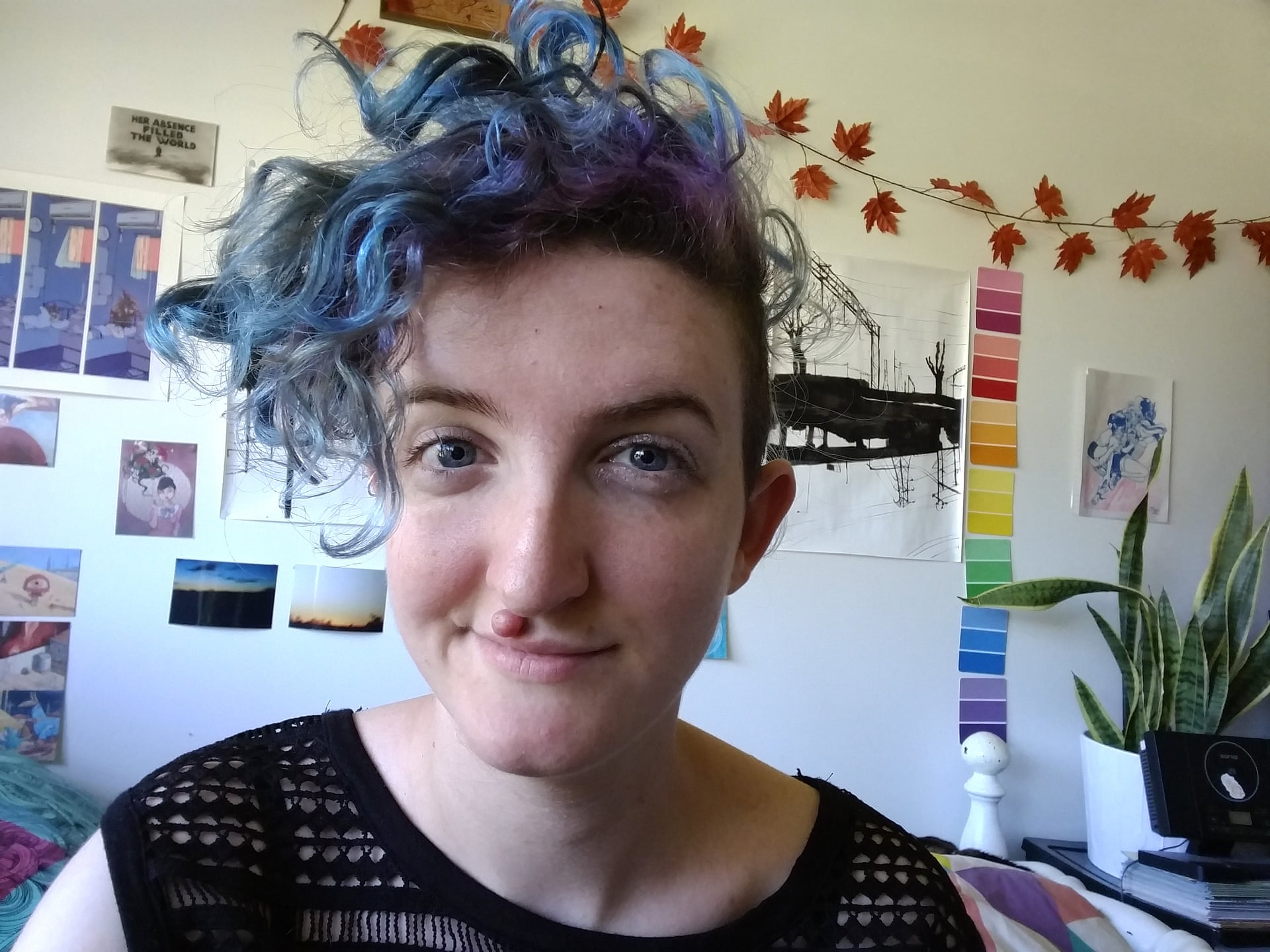
Image courtesy of The Guardian

“I had one review that was very resentful of what they called my ‘gender agenda’,” they laugh, adding, “People who don’t think they know any trans people have been like ‘Oh my god there are so many’, but it reflects my real life.”

Evans’s critics tend to accuse their work of pushing ‘political correctness’, not realizing that they are in a shrinking minority. A 2017 study by GLAAD found that twenty percent of Americans between the ages of 18 and 25 identified with a sexual orientation other than heterosexual and a gender identity other than cisgender.

“One-fifth of millennials identify as LGBTQ in some way and I love it,” Evans says, “Everybody is trans, so everybody’s going to be trans in the book!”

Ida follows the eponymous Ida Wagner, a young woman living in the Dandenongs region of Victoria. At the beginning of the novel, Ida can travel in time by slight increments, allowing her to rescind any decision she makes. However, she soon begins traveling to paralleldimensions – some of which are hauntingly bleak – and finds herself hounded by mysterious doppelgangers with malign intentions. Yet, despite this, Evans does not consider Ida science fiction.

“Scifi is about highlighting human nature by taking a human out of their natural life and putting them some place alien,” they say, “And I love science fiction, but for me, Ida is contemporary fiction in the way that it’s rooted in everyday life.”

This distinction is an important one. Treatments of gender in science fiction are rare, and many of those already seem outdated. Ursula K LeGuin’sThe Left Hand of Darkness, for example, while nonetheless on the cutting edge in its time, presents a non-binary conception of gender as something wholly alien. Evans, in contrast, rootstheir spectrum of queer and transgender characters firmly, not just in the “real world experiences”, but in the distinct and lovingly rendered landscape of suburban South-East Australia.The tree-ferns, drizzling rain, and smattering of Australian slang constantly reminds readers that they are not on another planet or in an alternate dimension.

“Is there a right way, then, to handle representation in fiction?” I ask Evans.

“It’s very dangerous to think there is a right way,” they reply,“Especially for gender stuff, because our understanding of gender is evolving rather rapidly at the moment. You read a book from even five years ago, and it feels really outdated.”

“So how do you approach representation in your work?”

“The way I do it is I can only speak for myself,” Evans says,“That’s also why I had so many trans characters in the book, to show that there are many ways to be trans.”

Photo courtesy of Joan Caldwell

As Evans and I talk, we reminisce about the young adult books that shaped our tastes and, quickly, it becomes clear that while there is no right way to approach representation, there is certainly a wrong way.

“How did you feel,” I ask, “When JK Rowling revealed that Dumbledore was supposed to be a gay character from the beginning?”

Evans audibly winces.

“When it first happened, I was pretty happy then, because I was just realizing that I was queer too,” they say, “But now, I find it really lazy and a bit shit, honestly.”

“Queerness should be evident in the story,” they add, “Otherwise it’s just cheating. People use the ‘scraps’ metaphor. Cis-het people get a meal and queer people get tiny little scraps and crumbs they are told to be grateful for. I think Dumbledore is definitely a crumb.”

“How do you make that evident in your stories?” I ask.

“A lot of my issue with queer characters, especially bi characters, in a lot of things they never use the word,” Evans says, “In every single piece of media where a character could be bi, nobody uses the word, which is why I used it in Ida. It would be cool to reach a point where you don’t have to use the words at all, but I don’t think we’re there.”

What ultimately makes Ida so compelling is the way it is fundamentally about the process of creating identity. To do so, Ida struggles against her ghostly doppelgangers, but for Ida’s genderqueer partner Daisy and her transmasculine cousin Frank, the struggle is against a world that is at times painfully homophobic and transphobic. Over the course of the novel, all the characters claim agency over external pressures and create their own unique gender identities through lived experience. Evans expresses this conviction in an article they wrote for The Guardian, saying, “We can make a new way of talking about ourselves, one that includes and expresses our gender the way we want to. We are writing ourselves into existence with our words, lives and stories.”[1]

Such is the power of Ida and novels like it. We need more stories that reflect our rapidly evolving understanding of gender and, more importantly, guide us in constructing and accepting our own gender identities. There is no doubt that Alison Evans will continue to provide some of the best work of this type on into the future.


[1]: Alison Evans, “My gender didn't exist in fiction when I was growing up – so I wrote myself into existence,”The Guardian, 28 February 2017, https://www.theguardian.com/books/2017/feb/28/my-gender-didnt-exist-in-fiction-when-i-was-growing-up-so-i-wrote-myself-into-existence
I loved and still love a certain type of fantasy novel - that kind of used-bookstore paperback, musty in odor, with a distinct, epic and painterly cover illustration. Even if you haven't read one, you'd likely recognize one immediately, and surmise correctly that its pages contain tales of dragon-slaying, world-saving, maiden-rescuing, swash-bucking, and adventuring.

And almost always, maps. Behind the front cover of one of these novels, you were sure to find a black and white hand-drawn map of the story's setting. These books taught me that a good fantasy story needs a good map. The maps hooked readers, showing unknown worlds waiting to be filled by the novel. Sometimes the maps themselves were better than the following story, even!

Map Created by Martin O'Leary's using his Fantasy Map Generator
It was this exact sentiment that led creative coder Martin O'Leary to create his Fantasy Map Generator. "I always had a fascination with these imagined worlds," he writes,"Which were often much more interesting than whatever luke-warm sub-Tolkien tale they were attached to."


The generator can produce random, finished maps at the click of a button. Many of maps produced this can be found on O'Leary's Uncharted Atlas twitter feed. If use the generator, though, and you want more control over what your fantasy looks like, you have options. You can shape your bodies of land through the "add slope", "add cone", "add inverted cone", and "add 5 blobs" options. You can exercise further control over your map by changing sea level and dictating erosion rates. In this way, the Fantasy Map Generator can produce a map that fits your story.


The site also give you the option to add cities and even generates names for the places on your map. This part of the map-generating process provides the greatest strength and greatest shortcoming of the generator. On one hand, the randomly generated names have a consistent feel, thus avoiding the laughable Aerith and Bob trope. On the other hand, the names are distributed in a restrictive way. Every city placed on the map is named, but the generator will only generate 5 area names, which always coincide with the first 5 cities placed on the map. Writers who want more than 5 areas or who want names for mountain ranges, islands, rivers, peninsulas, or other landforms may want to run the generator multiple times, use O'Leary's Name Generator, or even just come up with names themselves.


Naturally, such a generator should not be a crutch. As a writing tool, Martin O'Leary's Fantasy Map Generator is a good place to start, but the nature of the world your randomly generated map depicts is up to you. O'Leary even invites courageous compauthors to take a look at his code and try modifying the generator to their liking. Personally, I'm tempted to try and rectify the limitations mentioned above (stay tuned and see if anything comes of it).


So if you are the kind of writer who loves nostalgia-inducing fantasy paperbacks, is looking for inspiration for their own fantasy novel, or just loves playing with these sort of creative tools, consider spending a few hours generating fantasy maps. Between this, Microscope, and Who The Fuck Is My DnD Character, there is no shortage of great tools for constructing a great, fun, high-fantasy narrative.

Go forth and write!


The author, Cam, performing her poem "DEFCON" inside of an art museum, July 29 2017

Two months ago,  I performed a spoken-word poem titled "DEFCON", named after our DEFCON military defense system in the United States. It was about a boy who I constantly felt at war with, struggling with our hookup past, tempestuous mental health present, and uncertain future. Each stanza escalated in passion and heartbreak as the numbers counted down from 5 to 0. By 1, I was screaming.

That was something I hadn't intended. It was a snap-decision I made during the performance, filling any breaths of silence with my echo. It was one of my best poetry performances ever, if not the best. And I felt beautiful for it afterwards - cleansed, powerful, freed from this torment.

Then, he texted me later that night. He sent me three words that unraveled every lesson my art had taught me, every ounce of independence: I miss you.

And that is the kind of blood oil that pumps through my machinery. I run on this toxic energy. My art is made of this smog. And somehow, I breathe this. It's romantic, this kind of heartbreak, this kind of pain I can transfer onto the page or onto the stage. Look at how much I have to say about the same thing again and again. Look at this solace of creating art out of misery. Look how beautifully I bleed.

Why am I a heartbreak artist? Why did a younger self live in fear of running out of heartbreak because it would mean running out of poetry? Yes, the cathartic aid of creating art out of pain is useful, necessary, glorious. But what about the same, repeating pain of boys or girls or any variation of a lover treating you like shit? Making you feel so not lovely, so opposite of glorious, like someone who is prettiest and most powerful when she is screaming about how much this hurts?

I worry that we see this substitution for therapy too often and everywhere we look. We see it portrayed in media --in TV shows, in books, in music -- as tragically beautiful. As though those words should coincide beside each other.  This art becomes our voice instead of verbalizing the problem, instead of calling it out and kicking it out. We think that this pain must merit some presence in our lives because art has such a great presence in our lives. So we skewer the two together, decide that we can't have one without the other. We air our grievances and breathe them in again, inhaling carbon dioxide. It's almost like after creating this art we hold on even tighter to the heartbreak.

I'd love to say I have some solution to this. I wish I could say that I'm not proud of DEFCON and don't still have the poem memorized, safety off, ready to fire off of my tongue, heartbreak so hot I can still taste the metal of it. I wish this poem singed him, wish my pain was an exit wound in his chest.

But it falls on deaf ears. Certainly, only others who love this kind of heartbreak can truly hear the rhythm of it. The one who it was meant for, who inspired it all, couldn't possibly see or hear it. Smog doesn't have eyes or ears.


Read the more from Cam Best on Floodmark

Photo courtesy of The Underbelly Hours  The Underbelly Hours
[WARNING, this post does contain sexual imagery and strong language, proceed accordingly - The Editors]


Floodmark presents: "Seven campus novels you could get from any competent MFA either born or working in the Midwest, but gay, because it’s genuinely so easy, you guys", by Matthew Fox Kerr. 


1. A Town With No Chill

In 1971, Z___, a senior at U____, takes advantage of the college’s liberalism and creates
an independent study course on 'community organizing', which he uses to organize a
series of increasingly controversial protests against the Vietnam War. His advisor is D___, a
recently tenured poet, who specializes teaching poetry about pastoral sex. The two of
them, although focused on the anti-war movement, write endless letters to one another
about Dagny Faire, a fictional poet known for a single volume of poetry, detailing his
affairs with his private school fencing instructor, his university boxing coach and, finally,
his alienist. The letters end ambiguously and abruptly, leaving the resolution ambiguous.


2. Strange Music from Across the Grove

Ivan, a 21-year-old former violinist, has never quite gotten over the publicity of his
childhood adoption into a wealthy Franco-Persian family. In this retelling of Chekhov’s
The Cherry Orchard, he is studying abroad; his only friends are his socialite younger
sister, Ava, and small number of gay men studying abroad. He is horrified and confused
as his mother, Adrienne and his sister, Lam, arrive in Miami and announce that the two of
them most drop out of school, in order relocate as a family in Switzerland. Ivan initial
protests, especially upon learning that Adrienne believes they are less than a year away
from revolution and that his family intends to marry him off to the son of French
mobster, and must come to terms with whether or not he is truly like the rest of his
family.


3. The Baffling Bolshoi Brothers

Danny van Eyck was born in South Korea, was adopted by a white couple in
Massachusetts, and then spent the next 17 years being told he was adopted from North
Korea. This information is final straw in his decision to transfer to another school. In the
meantime, he’s just gotta spin his wheels listening to extremely Christian lectures on
science, Tolkien and advertising, acting in a royalty-free piece of Cold-War propaganda
about Chinese acrobats running away to become missionaries and practicing gay sex with
his co-star, Other Asian Danny, who’s also not Chinese.


4. Aristophanes The Frogs

Myron van Veen is excited to go to college, where he can make art and do drugs, not
necessarily in that order, but hopefully at the same time. After a disastrous first trip, he
becomes obsessed with classmate Alexander Richard Conrad Hyde, a.k.a. Connor, whom
Myron’s convinced is his 'Dark Half.' He also finds himself in a love triangle between
anonymous students, 'California', a religious woman studying mycology, and 'R*ger', a
sexually liberated boy, who excels at multiple division III sports. He produces art
prolifically but, perhaps unsurprisingly, most of it isn’t very good.


5. The Father

Beginning the morning after their celebrated scientist parents were convinced the world
was going to end, stepbrothers Sandy and Che (Singles Tennis and Intramural Lacrosse,
respectively) silently contemplate if going to the same college where their parents teach is
a good idea. The school, an unidentified Chicago school referred to as The University, at
first provides ample opportunity for them to develop their separate identities, they soon
find themselves pursuing the same man, an ethno-botany PhD and small time pot
dealer named Jack Amsterdam. As he plays them against each other, the resulting feud
results in expulsion.


6. Snakedick!

Pledging Kappa Omega Nu involves breaking into the reptile house and fucking
somebody doggy style. So Michael John-Thwarton doesn’t super get why everyone
freaked out when he just took his boyfriend. The resulting web of intrigue spans
generations and poses tough questions, about class, masculinity and anal sex. Michael is
mostly uninterested, and is much more pointedly concerned about why nobody will
answer any of his questions about the lizards.


7. Imagine the Horror

Ben and Josh are identical twins participating in a sleep study. When Ben goes to sleep,
Josh wakes up; when Josh goes to sleep, Ben wakes up. Each is living in a world where
they each drowned the other by accident as a child. When he wakes up, Stephen
Woodridge Wells discovers that he imagined both lives and remembers them in great
detail, despite being extremely unsure of his own life. That fall, he returns to a college
campus he doesn’t recognize, and discovers he lives a large house full of handsome men
his age, whose only common social connection seems to be a house-wide book club,
during which scenes from Ovid’s Metamorphoses are read, discussed, and, occasionally,
acted out.


[Cover sketch currently unavailable]


In his head, Matthew Fox Kerr usually refers to himself as Sludge Johnson. He previously was an extremely terrible intern at a tech review website and is working on one of these novels, but she wont tell us which one.


Cover illustrations my Matthew Fox Kerr and Vernon Meidlinger-Chin


Perhaps you find you have this in common with me: you listen to a song more for the lyrics than the music. Music is a large percentage of what motivates me to write poems that can remain silent on a page. Don’t get me wrong, I have genres of music I don’t like very much in general, and ones I prefer, and sometimes a vocalist or style is a deal-breaker. But much like I took you through Modern Baseball’s Holy Ghost over the summer, I’d like to take you on a lyrical journey through one of my favorite albums of 2016: The Altar

The Altar is the sophomore record of artist Banks (full name Jillian Banks), a follow-up to her debut album, Goddess. While looking up other reviews of this record, I found a few different sources, including Pitchforkslamming the record, asserting that Banks tries for an edginess she doesn’t achieve, and her lyrics and vocals are often too strange to captivate a listener. Though I’m certainly biased, being a Banks fan for almost two years now, I found this surprising, given that Banks’ weird lyrics and brutal vulnerability are what make her music appealing to me as a listener. As my friend and fellow writer Sage wrote in a blurb about the album, “…by the end of the album, you’ll realize that Banks’ desperation to prove that she is indeed, dangerous, becomes counterintuitive. Altar shows Banks more vulnerable than ever. But this type of vulnerability is accompanied by confidence and anger- a new sound for any woman in the music industry.”

It is particularly this “counterintuitive” blend of vulnerability and anger that makes me such a huge supporter of Banks and The Altar. Speaking for myself, I know how many times I can contradict myself in a day, through a trauma, or in general. I find a lot of her work, past and present, revolves around the push-and-pull of human relationships, how we inflict hurt one another and how we internalize hurt inflicted upon us. Banks speaks truth to the fluidity of passion, proving the complexity and coexistence of a myriad of damaged human emotion. Without any further rambling, here’s a selection of my favorite lyrics from each song on the album.

  1. Gemini Feed
    “And to think you would get me to the altar/Like I follow you around like a dog that needs water.” The idea of an altar becomes something darker on this album. Originally, and in context, it draws to mind an altar of marriage—but something darker is going on, something sacrificial, cause the word altar to expand. This song contains a lot of beautiful imagery in terms of frustration and righteous anger, alluding to an abusive or manipulative relationship.
  2. Fuck with Myself
    “I got two diamonds and a feather/Gimme three reasons why we ain’t together/I push my body through the floor.” Both metaphorically and literally, confidence and impudence meet to create this “self-love” tune. 
  3. Lovesick
    “Cause I'm lovesick/I ain't even ashamed, oh oh/And I'm hard up for some time in your sheets, oh oh/Would you been down to spend all your time with me?” While I have to say this isn’t a favorite on the album, nor do I find it particularly “poetic,” I do like the movement of (especially a female) artist proclaims she wants and enjoys sexually expressed love.
  4. Mind Games
    “Better look amusing cause my addiction to/These contradictions make it confusing/And if I walk away I'm scared I will find other muses/Cause I know you like olden days/I don't understand, you claim that I'm a handful/When you show up all empty-handed/The way you say you love me/Like you've just been reprimanded.” These lyrics call to mind Vernon’s article on muses, as it is clear that the relationship between the singer and the person sung-to is somewhat surface level and idealistic, rendering it unhealthy. This song digs into the platitude of loving the person versus loving an idea of a person, and like all conflicts, both sides seem to love and hate the “game.” Dating truly sucks.
  5. Trainwreck
    “I heard it from the state/They told me you were never gonna let me get away/And if you took me fishing, you will never give me bait/ I had to get away, I had to get away, I had to get away/Hey, you try to compensate/You thinking with your one brain, I should decapitate/You show me all your letters and I should've confiscated/Both my eyes were weighted, I had to get away.” This song holds a special place in my heart because it somehow combines catchy linguistic music, anger, desperation, and humor all in one go. The lyrics are somewhat disjointed, nonsensical pieces of rhyme without reason, connected through emotion coming through in the vocals. For whatever reason, I picture the Greek mythology characters of Tantalus and Sisyphus while listening to this track, probably due to the dead-end, repetitive, disillusioned relationship Banks refers to.
  6. This is Not About Us
    “What you told me/It never mattered/I never needed/This is not about/That you were tongue-tied/And what you sold me/I never bought it/This is not about/How I found out/That you were vacant/I never stood up/This is not about/All the times I tried to prove to you.” Like with “Lovesick,” I don’t find this track particularly poetic, but barer boned: the speaker has something to say and she’s saying it, point blank. However, this is another song in which I nod to Sage’s assessment of the album. Banks is telling the listener all about what the song is not, as if a sign of defensiveness, but simultaneously divulges intimate details while trying to put up said wall. 
  7. Weaker Girl
    “I'ma let you know what you don't wanna know/We just gonna see what we gonna see/Cause I'ma need a bad motherfucker like me.”
    Another to-the-point song, a great confidence booster. It documents the singer’s movement and growth away from a toxic relationship and expectations of another.
  8. Mother Earth
    “Underwater, consuming all my kind/Destined for alterations/And my mind ain't aligned for her daughter/I know I'm mother earth, I see the weather.”
    This track is a reminder that you are a force of nature. The power to heal, the power to alter the places in which you don’t fit, or that don’t match you values, the power to express your sexuality, all lie within you. The song is self-intimate and poignant, sacrificial but self-sufficient.
  9. Judas
    “Don't need you to make an effort, this should be effortless/Nothing can last forever, you're such a pessimist/I was your prized possession, and who was your exorcist?/Thought you was heaven-sent, you left for the hell of it.”
    These particular lyrics, besides just sounding satisfactory to the ear, I believe to be more complicated than they appear. Personally, I think this is a call and response between two voices, representing either internal conflict or conflict between two people. Ultimately, this metaphorical song is all about betrayal, and this betrayal extends beyond a lover and into the strife of one’s own mind. 
  10. Haunt
    What do you want? I wanna know/I brought a dandelion you could blow/While you stay mourning for something creative/But memories baited from your loneliness, I see.”
    “Haunt” is another track that is more straightforward, speaking directly to the disappointment of loving and giving to someone who is more wrapped up in themselves, as you try to protect yourself from the damage. The image of someone handing a dandelion to another is childlike, reminisce of an innocent, altruistic type of love, making both the obsession of the speaker and the apathy of the spoken to heartbreaking.
  11. Poltergeist    
    “I started all the wars, I started all the wars/I've been getting messages from my deep waters/I'd be a resentful caretaker/Blame me for your false indicators/You mistaking all my mistakes for my crooked nature./Oh my god, I think I saw a ghost/Follow me everywhere I go/Don't even try to get creative/I smell a clown looking goofy, dressed up as a native.”

    The Weeknd’s backing vocals on this song are haunting, speaking of a haunt. It was difficult to pick favorite lyrics for this song because like “Trainwreck,” it is one of my all-time favorites on the album, and the track in its entirety is a beautiful, poetic, honey-dripping-bitter way… of calling someone out on all of their bullshit, while also owning your faults. 
  12. To the Hilt
    “People say we're better off, you couldn't keep up/I still keep one broken piece/The one that fits in that chip on your shoulder/When we made our master plans/Is this where you thought we would be standing?”
    One of the few true ballads of the album, the word “hilt” itself is intriguing, referring the handle of a weapon. Banks speaks of “dangerous love” while avoiding sounding trite through honesty and vulnerability. Perhaps she is referring to the same lover on some of her angry songs in this song—and true to the complexity of strong feelings, she expresses another side of her grief here. 
  13. 27 Hours
    “So you like the fear of falling/But you stand there looking dumb/Why'd you come here in the first place?/Baby, I am not the one/How can you not walk away after everything I've done?/It's been 27 hours since we even saw the sun/Since we even saw the sun.”
    Oh, hey, have you ever been recklessly self-destructive and then had the audacity to feel annoyed that people have the nerve to love you through it? Well, hoo boy, do I have a relatable song for you! Don’t worry. I can relate too. When you go 27 hours or longer without seeing the sun, it might be understandable to start burning things for light. 


    Hosting a dinner party with literary geniuses as guests sounds like a dream come true… discovering that they’re all getting killed off one by one is more of a nightmare, but exactly the case for Edgar Allen Poe’s Murder Mystery Dinner Party. This YouTube series, created by Shipwrecked, started as a Kickstarter project back in February 2016, and its season finale aired on Halloween. So you can venture a guess as to what I was doing on All Hallow’s Eve…

    (source)


    The Persaud siblings started their characterizations as Edgar Allen Poe (Sean Persaud) and Lenore the Lady Ghost (Sinead Persaud) in their series A Tell-Tale Vlog. Somehow, despite Poe’s severe social awkwardness, he has managed to invite authors such as Ernest Hemingway (Joey Richter), Oscar Wilde (Tom DeTrinis), Charlotte Brontë (Ashley Clements), and… Emma Dickens (Sarah Grace Hart) or whoever. Of course, a murder mystery party wouldn’t be complete without Constables Jim and Jimmy (Jim O’Heir of Parks and Recreation, and Jimmy Wong) checking in on the mayhem.

    This web series has got to be one of the dweebiest, most wonderful concepts I’ve encountered in my life. Literature typically is limited to the page, but seeing appreciation for literary artists on the screen is almost too much to bear. It’s hard to imagine, at times, that there are other people out there who are equally obsessed with books and authors and poetry. This series is a sort of fan-fiction of the authors, imagining how writers and poets would have interacted with their contemporaries. It’s like Midnight in Paris, except it’s actually good.

    The episodes are chocked full with literary references, terrible puns (my favorite), boisterous comedy, and drama. While watching the series with friends, we definitely were kept in suspense ‘til the very end, unsure if new characters would make appearances, or if deceased characters were truly dead. If I had to pick a favorite, I would say that the rugged alcoholic Hemingway would be it (that’s probably the first and only time I will compliment Hemingway)
    The location is extravagant and absolutely perfect. The costumes and hair are beautiful period pieces. The color edit to the film gives it an eerie candlelit ambiance. The music is a subtle but strong foundation to the story. The actors are obviously dedicated to their roles, and I can barely imagine them outside of character.

    After watching Mary Kate Wiles’s (Annabel Lee) behind-the-scenes video in which she vlogs about the YouTube series, it’s easy to forget that this was an indie production. The budget was only $72,141, and when taking into account all of the actors, the location, the crew, and many other fine details, this is an amazing feat.  As someone who works with an out-of-my-own-pocket budget for my own films, who works with actors around their college class schedules, I’m in awe of how dedicatedly this production worked towards their passion project.

    I really do feel like this web series is a staple for the online literary community – as big as the first person who decided that they were going to vlog about books they recently read. The series deserves so much more love and support than what it currently has. My hope is that you’ll watch the first episode and follow the series through to the end, appreciating the representations of our beloved eighteen hundreds artists and the production team who created them.


    Watch the first episode:


    I:
    L’s horse is a chestnut mare, fifteen hands, that he has named Beatrice. Beatrice likes carrots, but prefers ones with the green still attached, which she eats prior to the root. Today, L is riding Beatrice in a joust. Their rival is none other than the king himself, for L has been accused of seducing the queen consort, which he has. He wears a ribbon from her on his sword arm and another on his shield arm, a gift from his other lover – a novice nun who, therefore, is a secret lover. 
    From the edge of the jousting grounds, the queen waves to L He lifts his lance in her direction. On the opposite end of the pitch, astride a black stallion, the king leers at L, fury in his eyes.


    II:
    L has a human heart, kept on ice, that he is to transport from the city of Q___ to the city of N___ for transplant into the body of a terminally ill patient. This is the first time L has handled a heart during the time it is without person. How does he feel to guide it through the liminal space between bodies? Is he, perhaps, proud of his unique role? Then again, does he see his responsibility, his task, as unenviable?
    In the operating room, the doctors allow L to place the heart into the patient’s open chest – which he does, delicately – before sewing her closed. L is still present when the patient wakes. She bursts into tears.
    “Are you in pain?” the doctors ask.
    “Yes,” she replies, “But I find, for the first time, that in that pain there is joy.”
    She wraps her arms around L and he presses her weeping face to his chest.


    III:
    Lances shattered, horses riderless, the joust has become a duel. The king attacks relentlessly, but L fights without anger. The king’s blows cannot find purchase in L’s defenses, and he grows redder, breathes harder, and sweats. How does L intend to escape this melee? Is he willing to slay his ruler and face the consequences? Does he believe he can fight to a fair stalemate and earn his opponent’s respect? The crowd can read nothing of his intentions. L’s handsome face betrays nothing. In a moment of pause, L turns to look at the Queen.
    She is weeping.
    L drops his defenses.


    IV: 
    A student asks L about so-called “Platonic” relationships wherein the two partners love one another deeply, yet chastely. L replies that this use of the term “Platonic” implies that chaste relationships are closer to the ideal form of a relationship, while sexual relationships are somehow less perfect. A real platonic relationship, in the true sense of the term, ought to be one that apprehends the platonic form of love. In such a relationship, the perfect selves of the lovers, the platonic selves, would meet and intermingle and would have perfect, platonic intercourse. 
    The student asks, “Do the physical lovers also have intercourse?”
    “Absolutely they have intercourse,” replies L, “They have intercourse, and it is perfect.”


    V:
    Under a beech tree, L’s lover tends to his wounds. The king has spared his life, but L may not return under penalty of certain death, L’s lover has turned her habit into a bandage, her crucifix into a splint. She kisses L beneath the beech tree, bitterly.
    The sun moves across the sky and, nourished by a meal of honey and rose petals, L summons the strength to rise. He kisses his lover a final time.
    He mounts Beatrice and departs.

    VI: 
    L’s boss asks him to get an email address and they meet together before a great computer screen. L’s boss walks him through the process of creating an email address, choosing a secure password, and choosing and answering security questions. L dislikes leonardcohen@gmail.com, saying, “That is not how I write my name,” and his boss changes it to l.cohen@gmail.com,  and L leaves, apparently satisfied.
    Since then, L’s boss has periodically received letters from L, hand-written on parchment and sealed with red wax, asking him to please reset L’s passwords and to remind him, please, of the answers to such questions as, “What as your paternal grandfather’s great unspoken fear?”, “In what city did you first fall in love with cold, still water?”, and “What was the name of your first pet?”


    VII:
    L lives in the attic of a former abbey in Languedoc. He has his meals brought to him by a half-blind peasant girl who speaks no French. She has a large, indigo burn covering the right half her face. L eats no more than once a day. Sometimes less frequently.
    The roof of L’s room slopes, his bed positioned where it is the shallowest. He has his lute tuned such that it emits the same low chord whenever jostled. An E-minor chord.
    “Thank you,” says L. 


    In memory of Leonard Cohen, 

    21 September 1934 – 7 November 2016


    (source)


    “…there is, for me, no difference between writing a good poem and moving into the sunlight against the body of the woman I love.” 

    –Audre Lorde, “The Erotic as Power”


    (source)


    Disclaimer/reader’s note: In the context of this article, I will be discussing the concepts of the masculine and feminine as Greek philosophy defined them, and as Westernized American imperialism defined them in opposition to one another. This means the masculine is equated with the mind, with the rational, with intelligence. The feminine is assigned to the body, to emotionality and physicality, to the unreasonable. 

    This is not to say that every man is masculine and every woman is feminine by these definitions, or that those of different genders or no gender do not have a place. It is my belief that we are all much too complicated to fit into this dichotomy: be it past, present, or future. 

    My discussions of the masculine and feminine in this article, and the excerpts included from Audre Lorde’s “The Erotic as Power” are in context with how contemporary American patriarchy has defined them. Lorde sought to subvert what was considered ideal and powerful, and this is my tribute to the essay that changed my view of the world and myself.

    ***


    “The Erotic as Power.” If you’ve never read poet and writer Audre Lorde’s essay, you may be thinking, as I did at first, that the piece has something to do about the power in sexuality. Are things about to get sexy? Well, the answer to that is that they could…but Lorde wants you to expand your definition of erotic and try to apply it to all areas of your life. 

    She opens her essay: 

    “There are many kinds of power, used and unused, acknowledged or otherwise. The erotic is a resource within each of us that lies in a deeply female and spiritual plane, firmly rooted in the power of our unexpressed or unrecognized feeling.”

    Are you familiar with any iteration of the following commands?

    “Stop being so sensitive.”“You’re just being emotional and dramatic.”“You need to stop letting your emotions lead you and think logically.”

    While there is a balance to be maintained between emotion and logic, it is pretty clear what our society tends to value more. The tender and feminine is seen as weak. The very reason we see the word “erotic” and think of the explicit and sexual is because passion is so often a half-nurtured emotion within us, that we feel the need, or are constantly reminded to tame and keep to “appropriate” levels. The masculine reigns. Anything else is hysterical, somehow less acceptable of a human experience. 

    Lorde goes on to explain the misconstruction of the erotic in her essay: 

    “The erotic has often been misnamed by men and used against women. It has been made into the confused, the trivial, the psychotic, the plasticized sensation. For this reason, we have often turned away from exploration and consideration of the erotic as a source of power and information, confusing it with its opposite, the pornographic. But pornography is a direct denial of the power of the erotic, for it represents the suppression of true feeling. Pornography emphasizes sensation without feeling.” 

    Porn is confused with eroticism because (at least mainstream) porn is dictated by the masculine. Pornography is stripped of passion, of any type of love for another or oneself, and condenses sexuality into emotionless imagery. It is simply the act of some sort of sex. Nothing more.

    In the same hot breath, our culture demands: have passions. Loving is important. But don’t be too passionate. Don’t love too much. You’ll end up in ruin. You’ll end up vulnerable. You’re holding yourself up as a target to be destroyed. When you’re not just performing an action, when practical objectivity starts to get clouded with feeling…you’re in harm's way. You may even tell yourself this, since you’ve been sold this narrative so frequently. 

    But Lorde says:

    “The erotic is a measure between the beginnings of our sense of self and the chaos of our strongest feelings.”

    To be erotic is to let go. And it’s terrifying. You are releasing the chaos inside of you and allowing it to be a larger factor in steering your words, actions, your life and your way of loving others and yourself. To be erotic is to be passionate and loving, and to find passion and love in your every movement and our every stillness. It is to be genuine most importantly to yourself, which entails letting ourselves feel what we feel without shame, without cutting out the ugly fits of rage, the bilecrawling fear, and accepting it all as a valid part of your experience. As valid as your fleeting confidence and happiness. It is to allow certainty and stability to become what they truly are, make-believe. 

    This opens a realm where you can live your most truthful, painful, and sincere life. You can stop going through the motions and allow yourself to reach out and touch, or to close your eyes and be touched, whether that mean physically or by any other means. 

    Erotic humans reject capitalism and patriarchy’s definitions of success and well-adjusted adulthood, Lorde says. 

    "The principal horror of any system which defines the good in terms of profit rather than in terms of human need, or which defines human need to the exclusion of the psychic and emotional components of that need—the principal horror of such a system is that it robs our work of its erotic value, its erotic power and life appeal and fulfillment."

    To value the masculine over the feminine is to cheapen your life, deprive fire of oxygen. But to be erotic is to value your imagination, that fickle-fleeting moment of sadness, the rumination on the texture of your own skin…to let this all mean more than a part of us to hide away, to keep to ourselves. It is power to feel. Passion is power, not silliness. Lorde invites you to try to understand why you consider certain parts of yourself or others as impractical. Where did you learn that you had to keep your emotions at arm’s length? What value system is giving the feeling that being logical rather than emotional is going to earn you more respect? Lorde dares you to subvert it all. 

    While I do say this essay changed many of my worldviews, I still struggle with this myself. But I think it’s important for highly sensitive people, empaths, poets—and even those with opposite interests alike to realize the erotic as power, and to consider Lorde’s definition of the erotic, repossessed from a culture that profits off of dismembering women’s bodies within porn and then turns around and shames women for enjoying or appreciating their bodies.

    Lorde writes:

     “The very word erotic comes from the Greek word eros, the personification of love in all its aspects—born of Chaos, and personifying creative power and harmony. When I speak of the erotic, then, I speak of it as an assertion of the lifeforce of women; of that creative energy empowered, the knowledge and use of which we are now reclaiming in our language, our history, our dancing, our loving, our work, our lives.” 


    Go get erotic. Embrace the fear and everything else that comes with it. With your body, your art, and your life. It’s about time. 

    Read more of Alyssa's work on Floodmark.


    © Floodmark Made By Underline Designs